
My Response to the May 10 “Statement from State Representative Dustin Miller (District 40)”

Yesterday, Rep. Dustin MIller released a statement on his Facebook page regarding funding for South City Park and other projects in Opelousas. The following is my reply.

We wish the South Park plans only cost the million dollars allocated from COVID relief funds. That would be reasonable and responsible. However, this is only a token of the full cost of this extravagant plan that you and a small group of insiders have developed without proper public input.

You state, “No local city government tax dollars are tied to the Donald Gardner Stadium improvements, the Community Center, or library renovations.” That’s misleading. Every dollar beyond the COVID funds comes from sales taxes paid by people who live, shop, and work in Opelousas. That is public money administered by local government. And if transparency is your goal, where is the full accounting of South Park spending—past, present, or proposed? To date, none has been provided.

The stadium renovation alone is projected to exceed $10 million, primarily funded by the Opelousas Downtown Development District (ODDD) through an additional one-cent sales tax collected at big-box stores. The ODDD issued municipal bonds to finance this, locking us into 15 years of debt, plus nearly $2 million in interest and fees, costs that are omitted from public statements. And if transparency matters, why are these decisions being made without the legally required oversight of a Parks and Recreation Commission, which the mayor has failed to appoint since 2019?

Then there’s the choice of location. The community center is planned for the site of the WPA-era pool—an area that requires destroying popular greenspace, major construction demolition, and subsequent fill that must meet engineering standards, all costly and unnecessary when vacant land is available nearby at a fraction of the cost.

Here’s an idea: Why not build the community center in the center of the community, where it could anchor downtown revitalization and support library programming? That’s the kind of impactful investment the ODDD is supposed to be making.

Meanwhile, the project lacks even the most basic financial planning. No published operations or maintenance budgets exist for the stadium or the proposed community center. Who will pay for utilities, insurance, staffing, janitorial services, or long-term upkeep? Artificial turf fields require specialized maintenance equipment and must be replaced every 6–10 years, at over $1 million per replacement cycle. Where is that money coming from?

Other communities have learned the hard way: these facilities are expensive and rarely break even. The original private funder walked away from nearby Pelican Park because annual costs were too high. That should be a cautionary tale, not a model.

All this unfolds while the city teeters on the edge of a fiscal cliff. On May 31, Opelousas will lose the source of 29% of its annual revenue due to the overlooked expiration of a long-standing one-cent sales tax. At the same time, our core infrastructure is in crisis. After this week’s rains, raw sewage is spewing from manholes, flowing onto residential streets, and into waterways that empty into the Vermilion River. Brown water continues to pour from our taps. Experts estimate that repairing our water systems alone will take $20–30 million. Securing funding for those repairs should be everyone’s top priority, because we are one incident away from a significant public health crisis. 

Yet, your focus—and the ODDD’s—has remained fixed on a flashy, limited-use stadium and recreation complex, not the urgent needs of a city with crumbling infrastructure, an aging population, and one of the highest poverty rates in the nation.

This isn’t just poor fiscal management—it’s misfeasance.

If you want the public’s trust, stop issuing misleading statements that justify these lavish and poorly researched plans. Opelousas needs investment in water, streets, housing, and jobs, not in distractions dressed up as progress.
Lavish Dreams, Empty Coffers: A Reckoning in Opelousas

By Stephen C. Picou (May 1, 2025) For over a generation, Opelousas has relied on a one-cent sales tax to fund nearly a third of its annual operating budget. That tax expires on May 31, 2025, and reinstatement requires a yet-to-be-scheduled public vote. This week, the mayor called for a special meeting of the City Council to continue public notice in support of a ballot initiative to renew the tax. But it’s a classic scenario of too little, too late to stop the cut, because this situation should have been addressed years ago.

How did we end up in this position? It’s not complicated. All city leaders had to do was read the Legislative Auditor’s annual financial report, which plainly states that the tax will expire in 2025. However, those entrusted to plan responsibly repeatedly overlooked this fact.

Over the past fifteen years, under the heading of Sales and Use Tax, the audit shared the following: “Proceeds of the 1% sales and use tax was initially levied by authority of a special election held on April 5, 1975, and was extended through May 31, 2025.” This statement does not hide in footnotes or small print; it is part of the main body of the report. Yet, until March of this year, no one at City Hall flagged it as an urgent concern.

One glaring reason for this oversight is clear: for the past three years, city leaders have been consumed by an ambitious and costly plan to transform serene and bucolic South City Park into a busy, commercially supported, paved-over, high-end sports complex. Fueled by city funds and special sales tax revenue from the Opelousas Downtown Development District (ODDD), this project became their fixation, while more pressing fiscal responsibilities were neglected. 

Some of us expressed serious concerns early on, warning that the plan was overpriced, poorly justified, and pushed forward with little transparency or public input. Instead of addressing our concerns, officials dismissed them—and us.

In November, as it became clear that substantial cuts to federal funding for social safety nets were imminent and could devastate Opelousas, the mayor rejected calls to prepare the city by reducing costs on South Park initiatives. He insisted on “staying the course” with the extravagant park development plans, the most expensive non-infrastructure project in the 300-year history of Opelousas.

In the days leading up to Mardi Gras, someone—whose identity remains unknown—must have finally reviewed the annual Louisiana Legislative Auditor report on the city’s finances and discovered the impending May 31 fiscal cliff. It wasn’t until April that the council could initiate the required public notice period.

When the tax expires on May 31, potentially severe cuts will soon follow. Who and what might be on the chopping block are issues that have yet to be discussed publicly.

Though I, too, was unaware of the looming expiration, my advocacy for fiscal prudence during these trying times was timely but insufficient. My analysis, rooted in extensive experience in government, community planning and outreach, economic development, and support for public parks and the environment, was that the city could not afford the costly plans for South Park, and that expenses to improve Gardner Stadium could easily be reduced by more than half while still meeting the needs of the schools.

For more than a year, I politely and professionally presented my questions and observations to the ODDD month after month. Initially, I was ignored. However, in recent months, as I uncovered and revealed details they kept from the public, I have faced scorn and derision. Last month, during an outdoor public event, a board member yelled at me, calling me negative, a liar, and an asshole, in front of city managers who chuckled like schoolyard bullies. I found the incident disheartening and unacceptable. That board member should resign or be removed.

Louisiana has the second-worst poverty rate in the continental US, exceeding eighteen percent. Nearly a million residents live below the poverty line. In Opelousas, the poverty rate is thirty-four percent, and in one Census Tract, home to more than 4000 people, the rate surpasses fifty percent. South Park is not in that tract; the much-neglected North Park is.

Due to special taxing districts like the ODDD, Opelousas has one of the highest sales tax rates in the country. The ODDD is mismanaging this revenue along with its responsibilities. They meet far from downtown at a location outside their district and operate with insufficient transparency and inadequate public input. Millions are being funneled into South Park without the legally mandated guidance of the still-unappointed Parks and Recreation Commission. What has transpired over the past few years, while they and the mayor were distracted by their envy and ambitions for a high-end sports complex like the one in much wealthier and fast-growing Youngsville, is nothing short of a travesty.

In his second term, the mayor is responsible for this situation and for failing to read the annual reports that clearly outline the pending sales tax expiration. Unfortunately, the phrase “the buck stops here” has taken on a new and painful meaning in his case. The bucks are stopping. What happens next is unclear, but we will all suffer due to the failure to prioritize investment in the basic functions of this needy, crumbling town. 

People in Opelousas are not clamoring for pickleball; they need food, affordable housing, clean water, good schools, healthcare, and job opportunities. Building state-of-the-art, limited-use sports facilities in a poor town with crumbling infrastructure, rather than investing in infrastructure and business development, is like putting a fur coat on a starving person dying of heat stroke.

Opelousas is a unique and special place. Our history, cultural mix, and location make it a desirable place to live. With the right infrastructure investment and leadership mix, this city can be a great place. However, this can only be achieved when the people elect city (and parish) leaders who strive for greater transparency, are guided by science and data, follow the law, read the audits, and incorporate the public’s voice. It’s up to all of us to do better! 

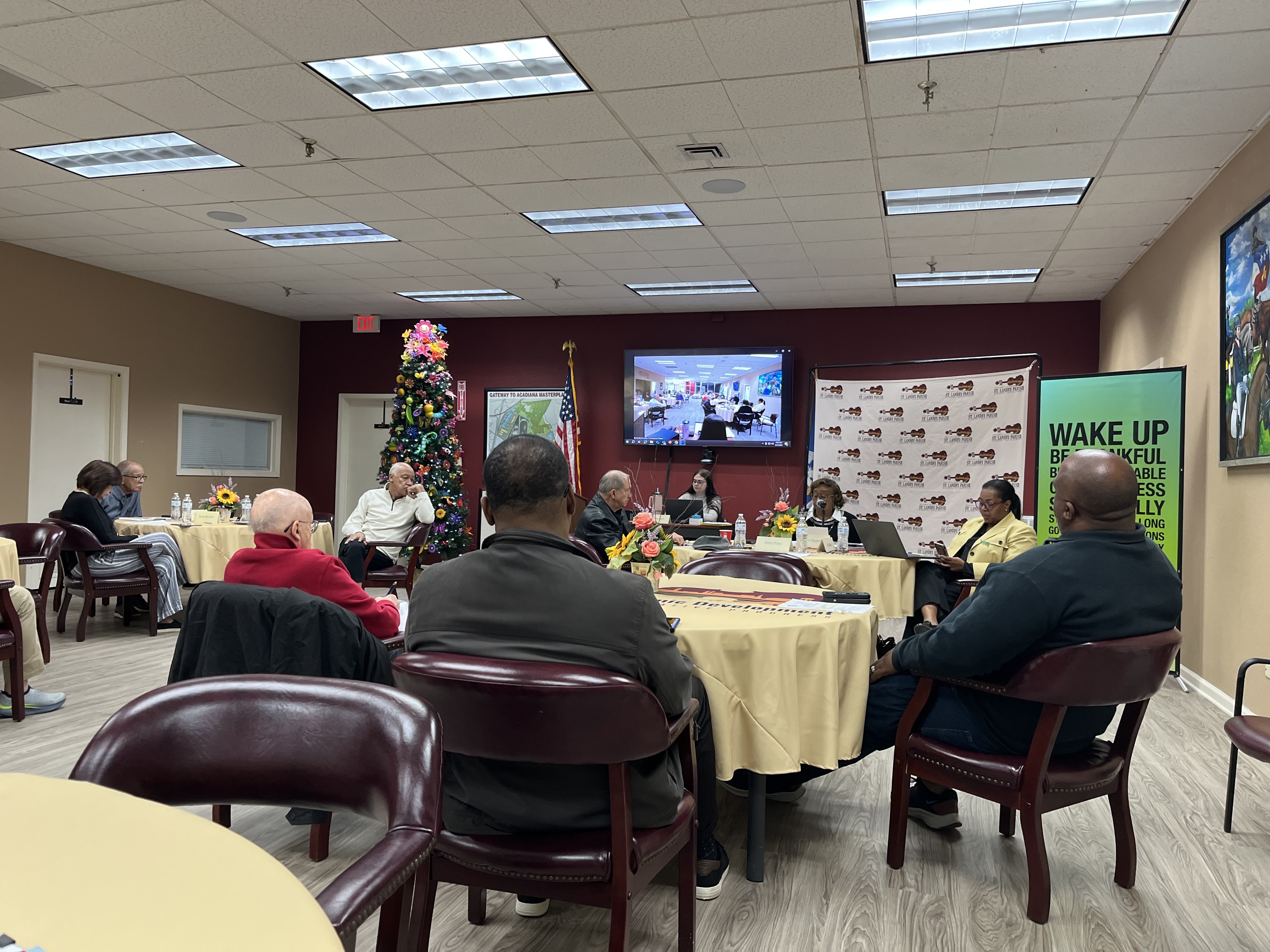
March 21, 2025, meeting of the Opelousas Downtown Development District. Held on the last Friday of the month at 9 am, outside the ODDD boundaries in the offices of the St. Landry Economic Development District (SLEDD), in the old Daily World building on the I-49 service road, nearly three miles by car from downtown.