Non-native plants ready to be plugged into the hand-laid brick and concrete holes in the nearly finished Great Lawn.
This week an 18 wheeler delivered a truckload of plants for the final stages of The Great Concrete Lawn in City Park. This multi-million dollar project sure provided a lot of money and work. That’s economic development. And that truckload of plants sure helped keep people employed—in Florida!
As the photo shows, a truckload of non-native species plants was delivered from a company with locations in Wisconsin and Florida. Cashio Cochran LLC, whose designs have disguised, smothered and killed the native landscape of City Park for the past couple of decades, ensured their role in history as perhaps the most un-enlightened park designers of the past half century with this last implantation of imported plant life.
Economic development in City Park...for an out of state plant provider.
But all is not lost…..yet. After this past week’s debacle of destruction, the Voodoo Music Experience (VME), tore up the soil under some of the most beautiful and fragile oaks in the park, we at least can look forward to when these non-native palms, ginger and other decorative plants blossom and bloom and hide those ugly old oaks that obviously were in the way of Cashio Cochran’s Eisenhower Era vision of tidy design.
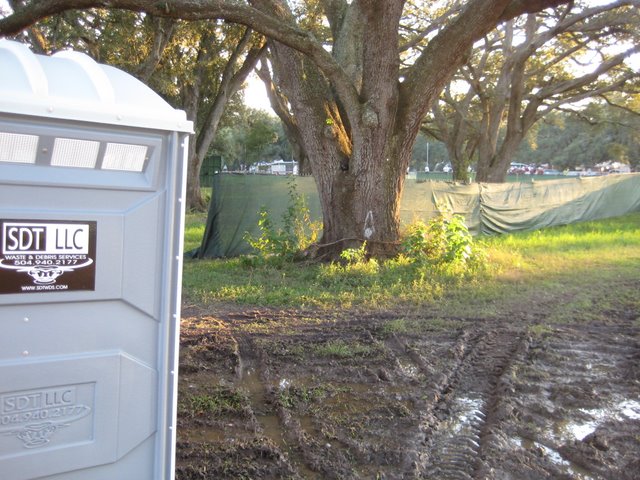
City Park brings friends together for the production of the Voodoo Music Experience. Rehage and Torres treat the park like, well, like what goes in that portabe potty.
What a year it’s been in City Park! Though I’ve only been blogging about it since March, we’ve seen bad decisions multiply like invasive species. The ironies pile up, too. The post-VME smell on Roosevelt Mall, despite the preponderance of familiar bull horns on the portable toilets, isn’t the aroma of the past couple of years in the French Quarter, but that of Bourbon Street of years gone by–a sour, sickly smell that this week’s blooming Sweet Olives can’t disguise. The damage, the smell, the bad design, the out of state plants, the heavy equipment crushing soil and roots, I guess it all smells like money to somebody. Or else we’d be hearing more than just me moaning and griping.
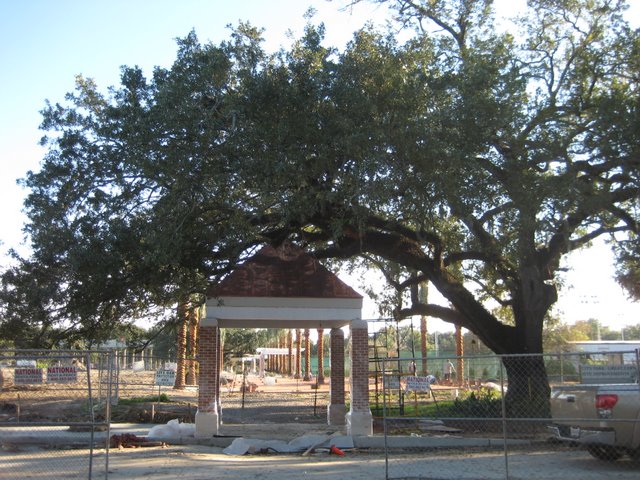
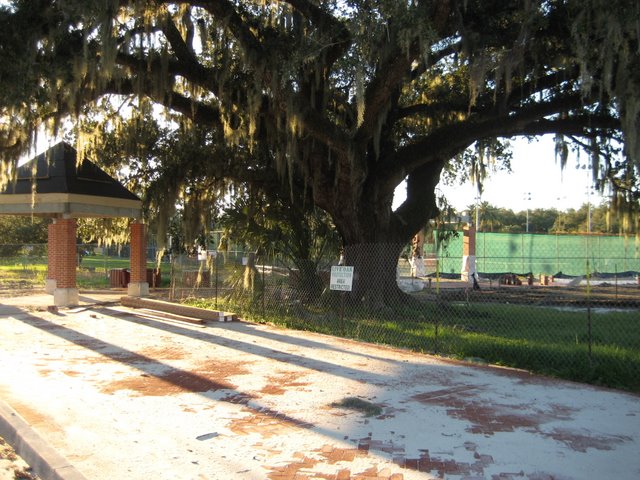
That copper roof will turn a nice shade of green. You think the designers planned for that to match the tree?
But, I guess I’m lucky. Unlike the those ever-more scraggly old oaks, I get to go home and put those smells and sights out of my mind whenever I want. And I have to assume that the folks who work there find all this quite normal since it keeps happening again and again and again and again and again…………..
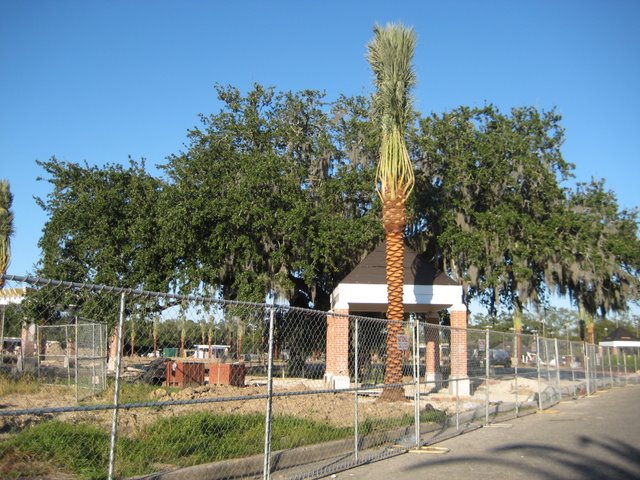
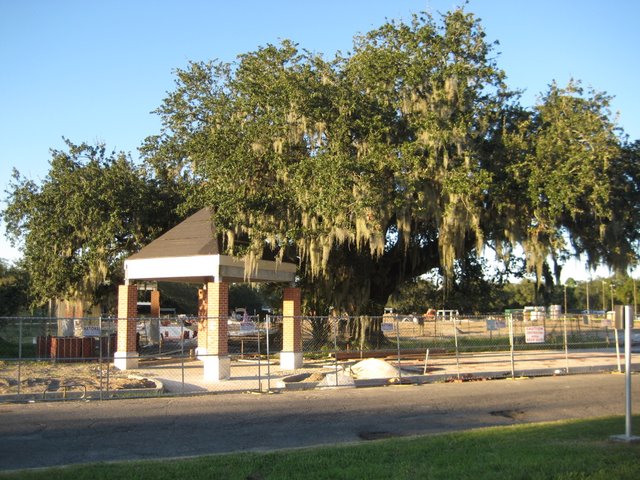
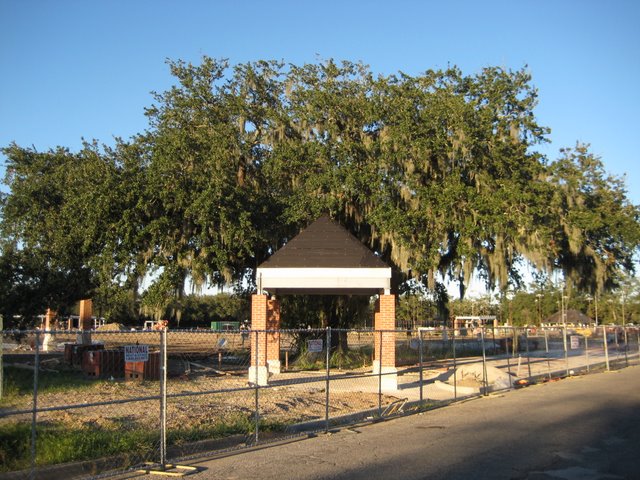
Cashio Cochran's big flourish--a palm in front of a pyramid hat building in front of an ancient live oak. BAM!
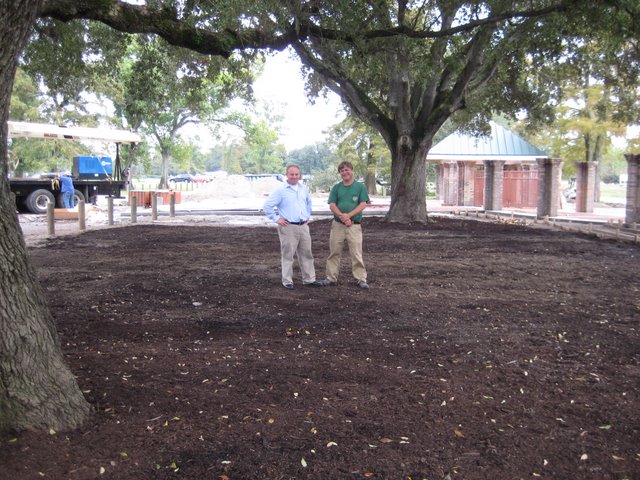
Newly hired LSU AgCenter horticultural agent Russell Harris (L) stands with La. Dept. of Agriculture & Forestry arborist Tom Campbell (R) under two live oaks where soil was aerated, remediated and improved at the new City Park Dog Park.
City Park’s consulting arborist, Tom Campbell, working with contract arborist Tom Benton, has taken the first step in best practices for live oaks with a soil remediation project for two trees at the site of the new dog park. This location, where cars parked for decades and compressed the soil, was a great candidate for the effort.
Working with what arborists call an “air knife” that injects compressed air into the soil, loosening it and allowing air, water and nutrients to flow, the soil was also amended with organic matter and now looks rich and life-giving.
The site will now serve as a test for future efforts. The next likely candidate area is the playground near the Peristyle, where years of human activity have compressed the soil and badly damaged many mature trees.
Kudos to Tom Campbell and City Park for taking the initiative to begin this much-needed process of restoration and best practices!
Just what every ancient live oak needs: a man-made building.
Thanks to Lolis Elie and the Times-Picayune for telling the story of how I’ve been trying to promote best practices for tree care in our area.
This is just a brief post for new visitors. I’ll be updating in greater detail later. But, I have to address a statement made by landscape architect Carlos Cashio in today’s article. He says that “sometimes you take risks to accomplish certain design elements.” My response is NO, YOU DO NOT TAKE RISKS WITH MATURE LIVE OAKS IN CITY PARK. Ever.
I post these pictures to let you decide for yourself. What is more beautiful: Carlos Cashio’s concrete and brick pyramid-hat building or God’s ancient live oak?
Architectural symmetry is more important to Cashio Cochran than the beauty of an older live oak.
It’s past time to let some of the true stewards and visionaries in the field of landscape architecture shape the future of this precious place. We already know what Cashio Cochran can do, and it does not meet my standards of the concept of legacy.
After I challenged this construction, sand was used under the brick rather than concrete. However, sand has little pore space to allow air, water and nutrients to reach the tree roots, so the tree will suffer so we can walk on bricks. Harming the oaks steals from the future and violates our history.
Orleans Parish Prison and Sheriff Marlin Gusman run a hell hole. The United States Department of Justice, in a 32 page report, spells it out in great detail. And perhaps now something will be done.
After the maiming and deaths of so many people, such as our dear, beautiful friend Cayne Miceli, it’s past time for change. The report is scathing and detailed, and perhaps will help us make that change.
The main fact stated by the report is that “we find that certain conditions at OPP violate the constitutional rights of inmates.” The report further states that “we find that inmates confined at OPP are not adequately protected from harm, including physical harm from excessive force by staff and inmate-on-inmate violence.” It continues, “we find that inmates do not receive adequate mental health care, including proper suicide prevention.” And completing the trifecta of tribulation for anyone with a health condition requiring medication, “we found specific deficiencies in medication management.”
Adding insult to injury, the report found that inmates “face serious risks posed by inadequate environmental and sanitation conditions.”
So, not only is the jail a medieval torture chamber where brutality, poor mental health standards and abominable management of medication can cause death; but, it is a filthy slime pit and potential incubator of disease. Oh, and it has inadequate fire safety standards, too.
The report goes into great legal detail in support of its findings. Then it gets into the meat of the Findings with this paragraph:
“We find that OPP fails to adequately protect inmates from harm and serious risk of harm from staff and other inmates; fails to provide inmates with adequate mental health care; fails to provide adequate suicide prevention; fails to provide adequate medication management; fails to provide safe and sanitary environmental conditions; and fails to provide adequate fire safety precautions.”
Under Finding A, INADEQUATE PROTECTION FROM HARM under item l: Unnecessary and Inappropriate Use of Force, the report states that “We believe there is a pattern and practice of unnecessary and inappropriate uses of force” and goes into detail regarding officers “openly engaged in abusive and retaliatory conduct which resulted in serious injuries to inmates.” The report then delves into OPP records to illustrate examples of brutal incidents.
The report in Item 1 goes into detail regarding Inadequate Policies and Procedures, Inadequate Use of Force Reporting, Inadequate Management Review of Use of Force, and Lack of Investigative Policies and Procedures.
Finding A-2 is that OPP has an Inadequate Classification System that results in inmates being improperly grouped, and produces a situation where “there is very little to safeguard against housing predatory inmates with vulnerable inmates. Not surprisingly, we found a disturbingly high number of assaultive incidents in the multiple occupancy cells.”
Finding A-3 covers Inmate-on-Inmate Assaults, going into detail on 10 incidents between May 2007 and August 2008 calling the situation “a systemic level of violence that poses a serious risk of harm to both inmates and correctional staff at the jail.”
Finding A-4 covers Inadequate Staffing and Inmate Supervision, which explains much about Finding A-2. But this section slams management of the prison, stating that “we found that OPP operates its facility without a staffing plan or analysis to establish the minimum number of security staff needed to safely manage OPP’s population.” This speaks directly to the fact that we elect whomever is popular to be sheriff. Gusman, whose prior positions in city government were purely administrative, is not a lawman or prison specialist. And evidently he hasn’t hired the kind of staff who follow basic guidelines such as this one regarding how many people it takes to safely run a prison with a large population of inmates. Does he rely on any other agencies to help him fill staff shortages when they occur? This report indicates that he has no plan.
On some occasions, the Justice Department report reveals, only a dozen officers were on duty to supervise 900 inmates! Here’s another disturbing quote, “On these occasions, the majority of the multiple occupancy cells housed more than 10 inmates and four of the eight floors had only one officer responsible for over 140 inmates.” If that nightmare doesn’t get you, how about this regarding staffing of the second largest facility at OPP, the Tents, “we found several instances during February 2007 thru May 2008 where the inmate average daily population was more than 580 and the facility had only seven officers on shift.” Of course this “places both inmates and staff at risk.”
There is a typo/flaw in the report, rather than Finding B it jumps to Finding C, (this is a typo, not indicative of anything missing from the report) INADEQUATE MENTAL HEALTH AND MEDICAL CARE. This is where the report obviously refers to Cayne Miceli’s case, though she is listed anonymously as “H.H.” Here is the section in its entirety. Note HOD stands for House of Detention.
“On January 6, 2009, H.H., a 43-year-old woman, stopped breathing while in restraints at OPP. H.H. was sent to HOD-10 hours after intake because she was considered hostile and suicidal. While in HOD-10, H.H. was placed in five-point restraints even after she repeatedly complained of asthma and breathing distress. H.H. did not receive physician or psychiatric care to determine if medication was appropriate or if placing an asthmatic individual in a five-point restraint was acceptable. Although she was under direct observation, H.H. was reportedly seen attempting to get out of the restraints. As OPP staff intervened and placed her in the restraints, H.H.’s body went limp. OPP medical staff responded to assess her condition. She was sent to the emergency room, where she was later pronounced dead.”
This is surely a brief and grossly incomplete telling of the horrors Cayne faced on her date with death at the hands of Sheriff Marlin Gusman’s staff— if indeed there were enough officers there that day to run the jail to satisfy his (now proven inadequate) level of standards.
The report also tells the horrible stories of two other inmates who in 2008 were placed in the restraint systems for more than 24 hours in one case and more than 35 hours in the other.
The damning evidence continues, “OPP has neither a restraint chair nor a safe cell. Inmates are restrained to metal beds affixed to a cell wall. The positioning of the bed prohibits 360 degree access to the inmate and, ironically, is itself a suicide hazard as even restrained individuals can strangle themselves by affixing clothing or sheets to this type of bed.”
I won’t go on with more details. We all know that OPP is a hell hole. But now it’s official, OPP is a threat to the health of all who are incarcerated and/or work there.
The Justice Department politely concludes the report with a pledge to assist and cooperate in helping OPP implement remedies. And it equally politely states that if “we are unable to reach a resolution regarding our concerns, the Attorney General may initiate a lawsuit,” and gives Sheriff Gusman “49 days after appropriate officials have been notified” to get started.
With the elections coming up, this report is damning of Gusman’s management and care, not only of the inmates and citizens of New Orleans, but of his own staff. I find this whole situation reprehensible and outrageous. I hope and pray the people of New Orleans wake up to this horror within our own government. And I also hope that the local papers cover this story in much greater detail than today’s rather short online story.
Cayne Miceli was killed by a chain of events that involved our health care system and our justice system. She received neither care or justice. She was spit-out by a for-profit hospital, then brutally handled by the justice system and died a torturous death at the hands of under-supervised public servants in a jail that is now declared a violation of our Constitution. Welcome to New Orleans, Louisiana U.S.A. in the 21st Century.
If Charity Hospital had been up and running, something we all know was possible within months of the flood and surely by January 2009, Cayne would be alive today. If Tulane/Hospital Corporation of America lived up to the highest principle of care for its patients, Cayne would have never been arrested. And if Sheriff Marlin Gusman was good at his job, his jail would not be a cesspool into which people go in whole and come out damaged or dead.
Our taxes support all these institutions and their managers, including Tulane/HCA. As we strive to make New Orleans whole again, we cannot allow these fundamental systems to operate in this manner.
And we cannot continue to elect incompetent people to positions of power, for it is killing us, quite literally.
Geez, I wonder how many of the tragedies that befall us down here are going to happen in Iowa? They’ve flooded and know what it’s like to deal with FEMA. Now they’ve had corruption of their film tax credit program resulting in their economic development director’s resignation. Who could have imagined it? Corruption in a tax credit program involving the film business! Here’s one link to their story. And here’s another.
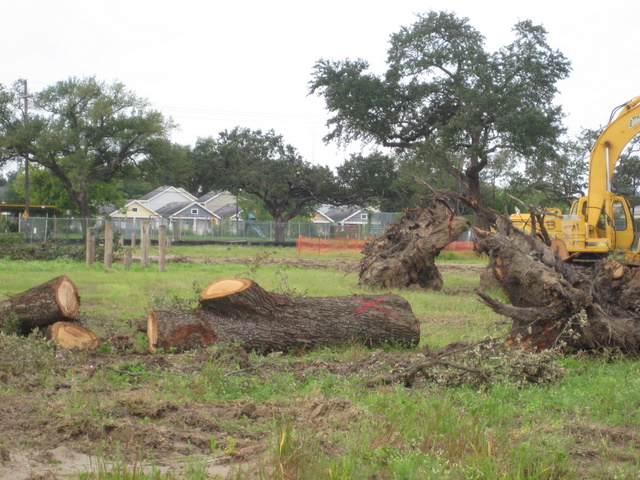
One of the more than 30 mature oaks destroyed by the redevelopment of the Lafitte Projects on Orleans Ave.
I really like the people behind the rebuilding of the Lafitte Projects. They’re nice. They said the new development will have many green and innovative features. But evidently everything must fit in nice square spaces and these trees are just not part of their vision for what the neighborhood should be.
30+ mature trees cut, 7 retained. And the beat goes on.
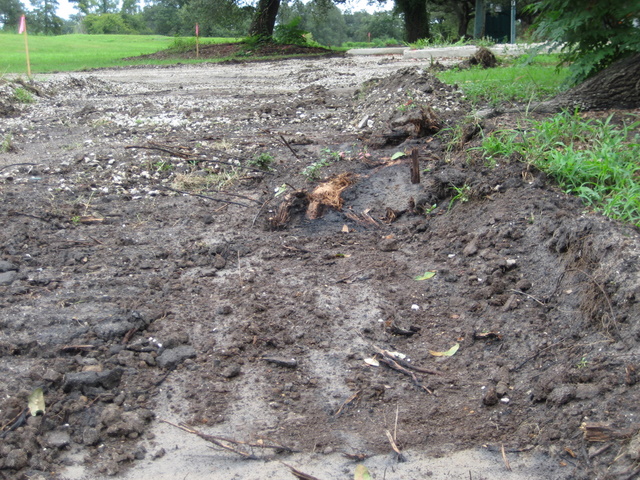
Bulldozed path under mature trees on Harrison Ave in City Park. Roots have been severed. These trees have been permanently damaged.
Good grief. I’m still trying to get to the bottom of this latest horrible development. Evidently the City of New Orleans bears some responsibility for restoring Harrison Ave through City Park. Not only are they widening the road–to the detriment of the oaks–but they’ve specified that a path be cut, evidently for sidewalks. Even the construction crew was surprised at the technical specifications which called for them to bulldoze the path. Now the trees have had their roots severed and are destined to be compacted and be abused by suffocating additions, likely concrete.
Why is it that as we rebuild we are killing so much of what matters in this town? What the floods didn’t take, stupidity is.
I couldn’t post all the pictures here so I built a Posterous page with 27 pictures. You can find it here at http://dyingoaks.posterous.com
Who is responsible for this latest crime against our quality of life?
Close-up of root damage next to a mature oak on Harrison Ave in City Park. This path was carved by a bulldozer to build a sidewalk where none existed before. Paths can be built without harm. Somebody screwed up big time.
Sign placed after damage already done to old live oak in City Park.
After sending a still-unanswered correspondence about how the new Great Lawn project was damaging one of the older trees in the park, I noticed that these signs went up. Doesn’t that make you feel better? No? I thought not.
I did learn that the park’s primary contractor for tree “care” has now written a prescription for the tree. So, after the destructive acts committed against this beautiful and iconic oak by the design team, management and the construction company, the park is suddenly looking after the health of the tree. Ah, irony is a bitter and repulsive dinner sometimes.
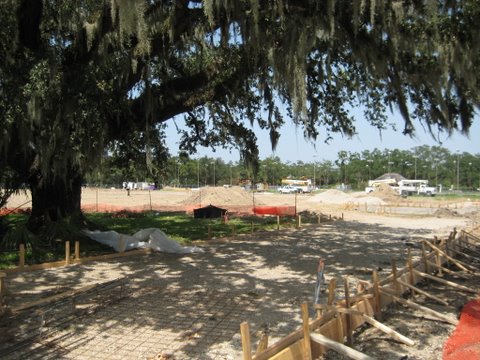
Easily two thirds of the canopy of this large tree has been impacted by destructive design and construction.Deeply trenched across the delicate roots, this work likely will be a sign or monument for the Great Lawn. Damage to the delicate root system will be revealed as parts of the canopy die-off in the future.Trees damaged by buildling of the Sculpture Garden and Pavilion of the Two Sisters. This kind of die-off is the result of failure to properly protect and care for these live oaks. This is the future if development continues without stronger protections and procedures.
Stately City Park Oak damaged by construction to build concrete forms.
Special note: I want to apologize if this post ruffles feathers. I admit that I am frustrated. I feel like I’m watching a loved one being assaulted and I’m supposed to be diplomatic and say, “please stop hitting her.” I pray that I find the inner-peace, wisdom and tact to evolve into a more effective and less-pointed advocate for a better world. For now, however, this is what I’ve thrown out there to try to find “light in the darkness of insanity” to quote Nick Lowe. I only want the best for City Park and our precious Louisiana. SP
Here are the gory details:
Well paid City Park designers, contractors and staffers continue to abuse and kill the precious live oaks under their stewardship. The Great Lawn project, part of the park’s Master Plan, is currently under construction. Just as with the Pavillion of the Two Sisters, a project that killed nearly a half dozen trees with at least one still barely holding on; and, with the loss of trees in the Sculpture Garden ongoing, all due to bad planning and implementation that failed to properly protect the soil and delicate root systems of the trees, the park is in trouble.
As I said in a previous post, City Park is being paved over. Already, an acre has been slathered with a suffocating coat of toxic asphalt. The Master Plan calls for many more acres to be encased in life-starving, impermeable concrete and asphalt because too many people in charge don’t know readily available procedures for Best Management Practices for a public park.
As I’ve noted, New Orleans City Park should be the green heart of the area. It should be the leader in sustainability and green principles to which we all turn to learn about and witness how humans properly manage the natural spaces our parks represent. After witnessing the construction of the Big Lake project and it’s poor choice in materials, tree selection and placement, and water management strategies–which connect to all these issues–I believe the park is in the hands of people who are reshaping it in ways that reflect the mindset of a bygone and downright ignorant time.
Here’s a letter I sent today to several people involved in the operations and oversight of City Park:
Hello:
I am writing to urge you to act swiftly to prevent further damage to live oaks in the park; and, to add appropriate arborists and local green/sustainable design experts to the paid teams developing and implementing the park’s Master Plan.
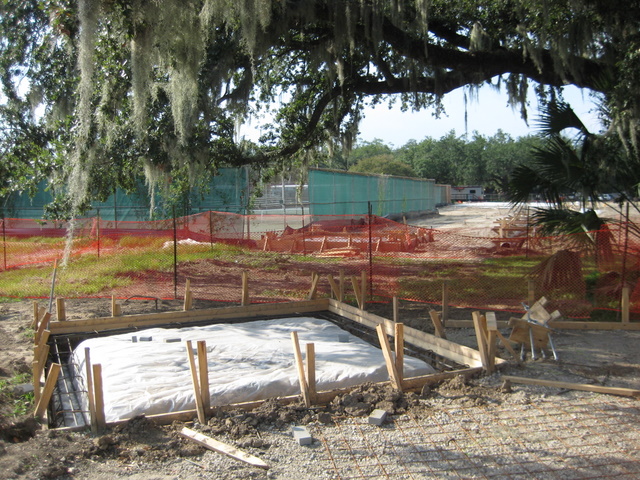
Apparently, the overall planner for the Great Lawn project designed it to include concrete structures around the base of the large live oak across from the Peristyle. The design does not take into account the needs of the tree. Damage is happening now, with large areas deep under the canopy dug-out, lined with gravel and framed for concrete. Additionally, there is a trenched square nearly a foot deep under the canopy, cut across the roots.
As a lifelong advocate for live oaks, a recently trained Parkway Partners/Louisiana Urban Forestry Council Certified Citizen Forester; and, having learned Best Management Practices at Jefferson Tree School, a continuing education program for arborists, I know that the top 18 inches of soil are the most critical to the health of live oaks. The photos show the “improvements” underway have removed the top layer of soil and deeply trenched a section, cutting vital roots.
This is clearly a case of destructive design and construction that should have been stopped at several stages of the process.
With the heat, drought and now root damage, this tree will suffer significant die-off from which it will never fully recover. I believe you should immediately bring in a local live oak expert such as Scott Courtright or Tom Campbell to evaluate and try to remediate the damage already done.
It is time for City Park to stop using impermeable hardscapes that suffocate the soil, kill the trees, increase flooding and erosion, and speed pollutants into our precious waterways. No more impermeable concrete or toxic asphalt!
In researching this situation I learned an important fact regarding landscape architects: their degree does not require them to be arborists.
To me, this explains many things regarding how and why trees have been damaged in City Park.
Trees seem to be chosen by the park’s go-to landscape architect with appearance superseding appropriateness. Paving systems are designed and built without an arborist’s understanding of their impact. This is not in line with Best Management Practices for native flora, water management, enhancement of the flyway and wildlife, or Low Impact Design. Any number of people in our area are experts on these matters. Some of them are cc’d in this email.
This is not a job for volunteers. Well paid contractors–using taxpayer funding and donations of people who assume we’re using BMPs–are currently creating these destructive actions. It’s past time to include paid local experts who can help the park become the green leader we all need and deserve.
Thank you for your prompt attention to this matter.
City Park oak damaged by trenching under canopy for concrete form.City Park oak being damaged by construction of concrete forms for Great Lawn project.Update on concrete form as of Thursday, August 6. Probably going to be some kind of iconic Great Lawn fixture or sign. So this oak is going to end up looking like an amputee as it dies-off thanks to this unbelievably stupid implementation of the design.
Ok, it’s time for me to re-visit a festering splinter. I apologize to readers who are bored with this subject. But here goes….
The basically non-existent Louisiana Music Commission (LMC), operating as a very minor component of Louisiana Economic Development (LED), continues to fail miserably at it’s mission “to promote and develop the popular, commercial music industry” in Louisiana (as per LA R.S. 25:315-317).
Of course there’s no budget specifically for music; and, with the state obsessed with Hollywood, chicken plants and sports, it’s no surprise that music continues to suffer.
As one of Louisiana’s signature natural assets–and one of the few industries here that continues to influence the world–this failure: to lead, to market, to support, and to recognize the importance of this irreplaceable and immeasurably valuable citizen-resource, is inexcusable.
The latest attempt to quantify Louisiana’s music resources reveals the depth of misunderstanding by economic development staffers, and represents another squandering of money on out of state “experts” who gather readily available data and then call it a study. Economics Research Associates in February released a state-funded report (anyone know the cost?) on Louisiana’s entertainment industry. It is a very revealing and, regarding music, deeply flawed document.
The music section begins with a lengthy overview (5 pages of 11) of the music industry using data readily available to anyone (even the LMC’s current director). The report then uses federal labor statistics and other industrial data to surmise that Louisiana’s business of music ranks well below 30+ other states, a patently ridiculous conclusion. And it is obvious that ERA did not fully understand, nor seek to document, the many facets of Louisiana’s unique music landscape.
What’s truly sad is that were the LMC fully funded and staffed with imaginative people, this study could’ve produced something worthwhile.
Back when we worked to gather this information, we used a combination of resources, including tourism data, staff researchers at LED, the Louisiana Music Directory and more. Since much of tourism is generated by music, that industry’s ups and downs are directly tied to music’s economic impact and contributed to our studies–this component was analyzed, by the way, by LED’s own highly qualified research staff. And, the only proper study ever done–by Dr. Tim Ryan of the University of New Orleans in the late 1980s–was not conducted by an out of state entity.
To continue to believe that only companies based out of state are capable of telling us who we are is a lingering problem in Baton Rouge and at LED.
The experts we need to help us analyze our music resources are readily available here in Louisiana. Utilizing this talent keeps money flowing between state government and higher education, helping to grow a new crop of experts and future businesspeople. In other words, it’s ECONOMIC DEVELOPMENT to first use your university resources to conduct studies.
Louisiana Economic Development fails at its mission when it fails to utilize readily available in-state resources within universities, nonprofits and businesses.
But I digress. When Ellis Marsalis, Bernie Cyrus and I were in charge of the LMC, we produced many reports on the state’s music industry. We posted these reports on the web for all to see. We distributed this information to the Office of the Governor and the Louisiana Legislature. And we determined that music’s impact on Louisiana was in the range of nearly $3 billion! Yet according to ERA, film is bigger than music in Louisiana. Really?
Of course Louisiana is spending more than $115,000,000 in cash money as tax credits to buy the friendship of the film industry here. And that money is giving lots of people work, many people from here–including some of my friends–and who knows how many from out of state. The data and the state’s “experts” have not quantified exactly how much of that money and those jobs stay in Louisiana.
But back to music, for that is our world renown, immeasurably valuable, historically significant, naturally occurring and most neglected asset. At a time when it is obvious that the recording industry is the component in the worst free-fall, both the state and ERA focused on the sound recording business as a measure, and as the only recipient of a little-used tax credit system.
Having done some of the earliest research of the state’s recording industry when this tax system was proposed–and kept out of the final drafts by a few nefarious folks, one of whom is headed to the pokey–I strongly believe that the current tax credit system is not what is truly needed. In my research–which involved me calling studio owners and asking them what their biggest problems were and what they though the state could do–I learned that studios sought sales tax relief and felt that the budget-oriented credits would both be little-used and have little effect.
ERA’s data certainly proves the little-used aspect, as only a handfull of projects have tapped into the credits. Of course the lack of staff at the LMC to process these credits is also partly to blame. But, as national data and the ERA report indicate–and anyone in the studio and music business can tell you for free–the recording industry is not doing well. Nevertheless, that segment is the focus of the state and of ERA.
The only apparent good news in the report is that music credits do better than film in the report’s cost-benefit analysis, supposedly generating $6.78 for every dollar in tax credits compared to $6.64 for film. However, since only $340,000 in spending was tallied for credits, the data says only a couple of jobs were generated. The study also notes that in 2008, $816,800 in productions applied for nearly $204,000 in credits. It’s encouraging to see the numbers rising. But it’s also frustrating to see the emphasis be only on this one aspect of the business. As a musician, I liken this approach to giving the cotton companies a tax credit during the waning days of slavery. What does this credit do for the musicians who are truly Louisiana’s musical gold?
Admittedly a few musicians have been hired to work on subsidized projects. And I don’t want to disparage the intention behind trying to support our vitally important recording studios, they need all the help they can get. But it’s almost like we’re subsidizing buggy manufacturers after the automobile was introduced. And studios, like every other aspect of music, won’t survive if musicians aren’t thriving.
Live music, which we determined in previous LMC reports has a multibillion dollar economic impact statewide, is given one short paragraph in the study–with no economic impact numbers. There are no inputs, no data, no charts, no information on taxes generated or jobs created in this live music paragraph.
Then the music aspect of the report ends. A total of 11 pages in a 90 page report.
There is no doubt that this report provides valuable data for state leaders. The study presents a very informative review of film incentives nationally. This will help people understand the landscape of film and media industry tax credits. And I’m sure this was the intent of all concerned in producing and funding this report. But, music is much bigger than this study says.
Louisiana music is a brand, unlike every other component of the report. And that brand has a worldwide value and recognition factor that needs to be tallied and supported.
The failure of the State of Louisiana–whether it is Louisiana Economic Development and/or the Lt. Governor’s Office of Tourism–to fully understand and support our vital music resources, isone of the great tragedies of mismanagement in the history of this state.
The power of our musical genres, of our music history and of our musical stars has never been fully or properly understood, valued, promoted or nurtured. What is even sadder is that everyone knows this and yet nothing substantial is done.
We convey an image to the world that our music matters. But it’s all just smoke and mirrors. We can do better.
Sidenote: Here’s a report we generated in 2002. It’s the kind of report that covers analysis of the industry both internationally and locally and includes all our projects, accomplishments and interactions for the year. Will the current LMC ever produce anything even remotely similar?










 NOLAmotion Blog
You must be logged in to post a comment.