OK, I went to Washington and lobbied for S. 414, the Credit Card reform bill. Here’s what happened. We started the day at Sen. Mary Landrieu’s office, so I was up first. The staffer (I don’t recall his name but will update this when I get it) we met with was a bit cynical. I was disappointed. I tried to emphasize that the banks were harming Sen. Landrieu’s strongest supporters and that it was time for her to stand up for the poor people who vote for her. He basically dismissed that line of thinking since the next election is years away. He claimed that Sen. Landrieu wasn’t afraid of angering the bankers (not that we said anything like that, though she is the recipient of more than $2 million in banking lobby money) because she had supported a credit union bill vehemently opposed by banks. We tried to get him to admit the banks were screwing us with these rate hikes, fees and other onerous new burdens. But he never seemed to sympathize.
Next we met with Travis Johnson, a legislative assistant with Sen. David Vitter. We we engaged by a smart, civil staffer who challenged us, debated us and gave us an opportunity to rebut and refine our arguments. We might not have changed the way Vitter will vote. But we had an intelligent and satisfying discussion with his staffer.
We also visited with very receptive staffers in the offices of Virginia Senators Mark Warner and Jim Webb.
Despite the fact that Sen. Landrieu’s opposition might be enough to stop the bill, there is a sense of optimism that credit card reform will pass. We were promised that if there is a signing ceremony with President Obama, that we’d be invited back!
I’m grateful to Consumers Union and the Pew Charitable Trusts for this amazing opportunity. It was amazing to see how accessible our federal delegation is to visits. I would advise anyone seeking to be heard to take the time to visit Washington and make an appointment. A staffer will be assigned to meet with you and give you the chance to be heard. Whether they listen is another story all together. But the experience is worth it because if you don’t try, nothing is guaranteed to happen.
Please call Sen. Landrieu’s office at 202-224-5824 and Sen. Vitter at 202-224-4623 and tell them you support credit card reform and want the senators to support their constituents and rein in the banks. The vote could happen this week or early next week, so call ASAP!
Consumers Union called Friday afternoon to offer me the opportunity to join them in the Capitol this week to lobby for passage of S. 414, the Credit Card Accountability and Responsibility Act. It seems that my participation in advocating for passage via http://creditcardreform.org caught their attention. My story was “one of the more credible ones” they’ve gathered and they want me to be a citizen lobbyist on Monday and Tuesday (May 4-5). They are covering the cost of the trip thanks to the support of the Pew Charitable Trusts.
I’m stoked, because Sen. Mary Landrieu is one of only 2 Democrats sitting on the fence regarding S. 414. She unfortunately voted to defeat the mortgage relief bill last week, saying that “my community bankers could be hurt.” Uh, Sen. Landrieu, your community is being hurt and we are the ones who elect you–by very slim margins each election–not the bankers.
FYI, Bank of America recently raised the rate on my credit card to 28% for no other reason than I have a fairly high balance. I have not missed a payment on any of the many cards I have and my credit is good. I’ve been quite outraged about this and sent emails to all my elected officials in Washington via the Consumers Union site. That’s what produced the phone call.
I’m going to be part of a team of citizen lobbyists working with Consumers Union this week. We’ll be calling on senators (the bill already passed the House) and their staffers, telling our stories and demanding passage of S. 414.
If you don’t already know, S. 414 protects consumers from unreasonable rate increase, bans marketing credit cards to people under age 21, sets clearer guidelines for gift cards (not allowing fees or expiration) and provides for higher deposit insurance levels–a component that also helps banks. The banking industry is squealing because the card limits hit their profit margins. But, had these despicable, greedy institutions done a better job of running fair businesses, they wouldn’t be complaining and we wouldn’t be rebelling against their usurious and unreasonable rates. What banks are doing to customers, young and old, is morally reprehensible.
You cannot escape from credit card debt, thanks to a bill passed by a bipartisan Congress during the Bush years. And now, there is blood on their hands. People are comitting suicide and murder over their indebtedness. (See Maxed Out, the 2006 documentary that exposes how banks and government created this mess.) We have to do something.
So, my advice to you is to become a member of Consumers Union, the nonprofit arm of Consumer Reports, and any other reputable organization fighting for the rights of the people. You never know, you might get to go to Washington, too.
I’ve decided on a new career that I know will make me rich. I’m going to be a chicken plucking, film making, sports team owning, wood pulping for export, drug testing entrepreneur! Yes, that’s the key.
Since it’s increasingly obvious the state doesn’t care for its arts, music, environment, mental health or safety, I figured I’d put my thinking cap on and ponder: What does the state really support? And, voila, I got the answer!
We’re spending $114 million buying the friendship of the movie industry, we’re putting up $50 million for a chicken plant near the Arkansas border and $20 million for a chicken freezer next to the French Quarter, we’re annually handing professional sports teams dozens of millions, we’re giving tens of millions to speed up the cutting of our mixed hardwood forests for things like wood pellets to be burned for fuel in Europe and landscape mulch, and we might put our money where the piss is by drug testing 20,000 welfare recipients.
Those are the businesses in Louisiana’s future!
On the other hand, we’re doing nothing to support music, cutting the arts, still don’t fully understand how to restore our environment, are closing and cutting mental health facilities and even have a bill ready for the upcoming session that allows guns on campuses… Hey wait, I just thought of something: bulletproof vests for teachers and students!
Hell, I almost missed a big one that could pay for my second Hummer. Yeah, it’s a great time to be in Louisiana, no foolin’…IF you know what you’re doing.
OK, so the numbers are in and, as reported today in the Shreveport Times, in 2007 Louisiana invested $100,000,000 in film (after recouping $14m in taxes) on $429,000,000 of film spending. Of course verifying these numbers, particularly the spending by film companies, is a fuzzy math situation in which we remain dependent upon the film companies themselves to report their spending, so I have my doubts as to the accuracy.
Can you imagine that if you were an investor in the film industry, say in a film fund, how much of a long term return your money might be getting? You’d be getting checks for the rest of your life and that of your heirs if you had spent $100 million in a film investment vehicle that spread your investments around the industry. But what does Louisiana get? One time, poorly validated “spending” by these companies that results in short-term jobs averaging $32,000. But we look good on camera!
If this is such a good investment, why don’t we do it for music? In fact, why don’t we do it for every business in Louisiana. If the state can directly spend a dollar and get back four, why not spend on restaurants, grocery stores, construction companies, or any business? Because it defies the laws of physics and economics. You can’t create a perpetual motion machine and you can’t use public money to create perpetual economic engines. For the public to benefit, any expenditure needs to produce more in tax revenues than it spends. Just as too many calories make you fat, too much spending makes you broke. No matter how you extend the numbers to “secondary spending” you cannot ignore the fact that more money is being taken from public coffers than is being replenished.
I’ve said it before and I’ll say it again: where’s Louisiana’s share? If individuals invested this much money in the film business, they’d be getting a a piece of the action, a return on investment. Why is this not possible for public investment?
Music is our true asset. Though we welcome Hollywood and the movie industry, it is not one of Louisiana’s naturally occurring assets. Music is our calling card to the hearts, minds and wallets of the world. Yet we continue to allow it to flounder, leaderless, budget-less and without accountability for what little is being done. The press and public remain silent about the ongoing tragedy that is the Louisiana Music Commission.
Here’s the kind of readily available information that used to be produced by the LMC and which was publicly available on the web until 2006 when the years of undermining by a small, avaricious group empowered by soon-to-be-jailed former Louisiana Economic Development (LED) Entertainment director Mark Smith and other cohorts finally prevailed in destroying the LMC:
In fact, let me state this: former LED secretaries Don Hutchinson and Mike Olivier, along with Gov. Kathleen Blanco and the aforementioned Mark Smith were to music what the US Army Corps of Engineers was to flood protection in New Orleans in 2005–a massive disaster with ongoing consequences that will affect future generations.
Of course, I could be wrong. In fact, I hope I am. Someone, please convince me that I’m wrong about all this and that Louisiana is better off because of these things. I’m a reasonable person.
UPDATED 1/10/09: Note: When I originally wrote this, many facts were unclear. Now that more information is available, I have re-written parts of this piece to reflect more accurately the chain of events and overarching realities that have come to light. This being a blog and not a printed publication, it is a living document and one that can be improved and edited to improve its veracity. I hope that’s what I’m doing. Regardless, I cannot possibly capture all the truths at work here. Suffice to say, Cayne turned to the system for help and it killed her.
Update: Jan 13, 2009-Shoeless Eric was with the family at Cayne’s bedside when the decision was made to remove her from life support. He’s created a moderated group site where you can find more information about what happened and what is going to happen: http://health.groups.yahoo.com/group/caynemiceli
Update Jan 14, 2009: Karen Dalton-Beninato’s blog on Huffington Post today is about Cayne. It’s a beautiful piece and features a piece Cayne wrote.
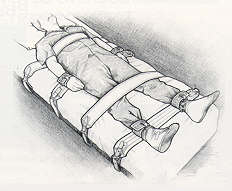
The lack of psychiatric beds, health care resources and basic human rights in New Orleans produced yet another tragedy. After being treated at Tulane Medical Center with a powerful steroid, prednisone, for her severe asthma, my friend Cayne Miceli believed she was having an adverse reaction to the drug. She sought to be re-examined and/or admitted and was turned away because the hospital felt it had done its job, and because she had no insurance. Unable to contain her frustration, her emotional state aggravated by the steroids, she flew into a rage and was taken away to jail. She allegedly attempted suicide and was put into 5 point restraints, aggravating both her mental state and her ability to breathe. She reacted badly to the restraints and was further subdued by two jail personnel. Subsequently, she “became unresponsive.”Jail staff intubated and “revived” her so that her “actual” death occurred at University Hospital with the decision of her family to remove her from life support. The facts are still unclear and may not be clarified for a while. But one thing is clear: the system failed her.
Cayne was a vivacious but troubled soul. She had a magical quality that connected her deeply to New Orleans. She was a survivor like the rest of us. She was full of life.
Cayne wasn’t afraid to reach out when she needed support. When she sought medical assistance for her asthma, it wasn’t done lightly. She has lived with asthma for many years. Cayne knew she needed help and did the best she could to get it. In Post-Katrina New Orleans, she found no room for her illnesses.
New Orleans without Charity Hospital is a city without compassion. That we continue to have too few psychiatric beds is unacceptable. That we continue to be haggling over the rebuilding of our health care infrastructure is abominable.
New Orleans is a city filled with Cayne Miceli’s, uncounted troubled and traumatized souls who keep things together most of the time. But when their lungs, hearts and minds can take no more, New Orleans provides no shelter, no bosom into which to retreat because Charity Hospital has not been rebuilt.
I now officially join the voices of those opposed to the tearing down of houses to build a new, fantasy hospital. Charity sits unused and ready to be restored while victims, the detainees–die lonely deaths in jail, our default system for handling the mentally troubled.
The people who seek to extend this process because they refuse to fix Charity Hospital have blood on their hands. I will remind them. Then again, maybe we all have blood on our hands these days.
Note: Jan 10, 2009: It’s clearer to me now that health and justice systems are in a dance of death lottery that can start when you say “I need help!” or merely, “I can’t breathe!”
It’s also clear to me that if someone at Tulane had said, “OK, we’ll examine you again,” instead of “call the police,” Cayne would probably still be with us.
Now that we know more about Cayne’s horrible experiences and death, the lack of beds is only part of this problem.
In Post-Katrina New Orleans, we live with layers and layers and layers of problems, of missed opportunities, of disorganization and incompetence that infect the system from within our “rebuilt” homes to the halls of power in Washington DC. I pray we see that improve in 2009.
I also learned that I have a dear friend whose brother suffered gross mistreatment in a local jail. That this isn’t the first asthmatic to die in a local jail. That the last person to die on that torturous medieval restraint system died a medieval torture death: dehydration.
It’s bad enough my country justified torture. Now I know that my community tortures, too.
5 Point Restraint System
And I’ve learned that best estimates put those shining new hospitals opening in 2016.
At the current rate of death and disablement happening in area jails, I’m probably going to personally know several more victims before the next seven years pass.
Our jails and prisons are maiming and killing too many people who often haven’t even been arraigned. And now our hospitals can’t recognize the symptoms of the drugs they administer and dump their patients on the police? Suffice to say I find this unacceptable/abusive/you fill-in-the-blank.
We’re losing basic human rights. I hope we’re waking up.
As Cayne so often said when she reached a stopping point in the conversation: “Yeah, yeah, yeah. Peace & Love! Peace & Love!”
<Sigh>.
Magical Cayne Miceli (photo enhanced by Jeremy Machalek of WhyArts.com)
It’s a damn shame how the few writers/publishers making money off Louisiana music have completely ignored the details of this story and its connection to the demise of the state’s main support mechanisms for music. I guess if the occasional ad money from the state keeps flowing, the criticism stays in check.
In this economy, nothing is what it was. And that’s bad news for the once-famous. Celebrity has changed. Thanks in no small part to the plethora of channels/movies/sites, the machinery of fame suffers from the media’s general state of dilution: there are too many sources pushing too many vapid “products” into a system that continues to expand.
Even athletes are losing ground. As business declines, endorsements are being withdrawn. You’ll be seeing less of Tiger Woods. And this year’s Olympic champions, despite record audiences and name recognition, are finding few companies interested in using their images. It’s a new world.
The narcissistic shallowness that is Hollywood will not respond well to being ignored. But the fact is, as things get worse, who cares about most of the pathetic tripe emanating from the movie and television industry?
I’ve said for more than ten years that the media giants are doomed. They played games with their accounting by constantly growing, masking their debt and overhead. Now, as the auto industry, which accounts for some 25% of ad revenues on television, pulls back, the media’s naked butts are showing.
Not that any of this is going to change the brothel-like affair Louisiana continues to have with the film and television industry. Consider this: if the State of Louisiana is willing to pay a percentage of the film business’ bill based on budget and impact, why can’t it do the same for music? Using the methodology of the film tax credit system, the state ought to be putting up millions to support our multibillion dollar music industry. Instead it continues to do nothing for music.
The silence from our tiny world of music writers and publishers is inexcusable.
Not that Louisiana can buy fame for our musicians. Fame will never be the same. But, the state shouldn’t be so in love with only one component of the media. Louisiana should love its music even more than it loves film.
Louisiana’s overly generous film tax credits finally made the New York Times. Thanks in no small part to the ease (caused by lax oversight) with which budgets are overstated and credits overpaid, film tax credits are being challenged around the country. Economists are having a difficult time justifying the state paying $27 million of a $167 million budget, for example. And if one compares other industries and businesses to the way film is treated by governments around the world, it’s no wonder people are starting to complain. Besides being unfair to every other industry, the tax credits have not been proven to be cost-effective.
To their credit, Louisiana commissioned a study to determine the economic impact of the film subsidies; and, lots of people are waiting to see the results. I’m sure few would like to see anything but a positive return on this creative investment. However, there are myriad questions that arise when the taxpayers become major partners in productions. Why, for example, are we not entitled to a piece of the pie?
If an investor puts up millions of dollars for a production company to produce a film, the investor is a partner. So, why aren’t we partners? If we put up 16% of the budget of a $167 million picture, shouldn’t we be entitled to the same financial arrangements as the other investors? And the same goes for sports and all other economic bailouts or investments by the taxpayers.
I’d ask former Louisiana film commissioner Mark Smith what he thinks, but he’s busy talking to the feds.
Of course my ongoing criticism of this investment of public money into the film industry is that Louisiana isn’t known for producing Spielbergs the way we’ve produced Nevilles or Marsalises.Why, then, can’t the state commit to properly funding work to support its historic music resources?
As has always been the case, Louisiana would rather support sports, film, petrochemicals and agriculture and do what it has always done: take music for granted.
With the State of Louisiana annually funding the Tipitina’s Foundation at a higher rate than it ever budgeted for the Louisiana Music Commission, it’s becoming more and more obvious that Tip’s has become the state’s de facto music commission. That’s fine because the foundation has done an amazing job establishing it’s model and growing it for the benefit of all concerned. Not only does the foundation create an invaluable networking opportunity for musicians via it’s offices and workshops, but it also provides jobs within its growing structure. And in an industry in which real, full time jobs are harder and harder to come by, this is no small feat.
I say kudos to Roland and Mary Von Kurnatowski, Bill Taylor and the staff of Tipitina’s Foundation. While the state neglects its own formal music responsibilities via a budget-less, office-less, website-less and functionally broken music commission, the foundation keeps chugging along, helping musicians connect with resources and, most significantly, each other as they struggle in the ever-more-difficult business of music. My hat’s off to Tipitina’s as they continue to grow.
Not that the Louisiana Music Commission is totally dormant. They’ve been planning, studying and meeting for more than 2 years now, having actually accomplished nothing. This is in sharp contrast to the work of the LMC in years past.
In our first two years, 1992 to 1994, with a total annual budget of $56,000, the LMC was a busy and productive entity. We created and produced two commercial radio shows, developed a live television show (LTV that went on to air 100 unique episodes featuring a total of nearly 300 musical guests), created New Orleans Jazz Centennial Celebration, secured the launch ceremonies for the Louis Armstrong stamp, saved the Aaron Neville Christmas Special which resulted in securing a $10,000 donation to Farm Aid (held at the Superdome that year), and more. Here’s a copy of a report from back then. It was on the agency’s website. But, as I’ve noted before, the url and 8 years of web postings were thrown away during the Blanco years. Interestingly, Gov. Jindal has reappointed one of the contributors to the LMC’s demise.
The LMC recently met in Shreveport and announced plans to try to attend MIDEM (a very costly undertaking) and to study Branson and Austin–all things that have been done before. They continue to be mired in outdated perceptions of the music industry based on the tired and often self-serving rhetoric of the commission’s reappointed chair, Maggie Warwick. And now, after 2 years of dawdling I believe it’s time for everyone to admit that the LMC is dead and that Tipitina’s Foundation is the best hope for Louisiana’s musicians seeking to improve their lives and business models.
But what do I know.
Here are more links to past pages on the defunct LMC site:
Too many folks in economic development overemphasize recruiting. At a time when most admit that Louisiana’s greatest export is our smart, talented, innovative people, highly paid government “leaders” continue to believe they can recruit outsiders to save us.
When I was at the Louisiana Music Commission, we used to joke that to economic development people an expert was someone from out of town carrying a briefcase. Nobody, it seemed, wanted to hear what “we” all have to say. Only the “experts” seemed to know up from down. Though we tried at every opportunity to bring an appreciation for indigenous talent to economic development, and tried our best to be a part of all aspects of the department, nobody wanted to hear anything from us unless it was about music; and, all-to-often only if it involved access to backstage passes.
I recently met with an important person from Louisiana Economic Development who believed that the music director needed to be “working the phones and recruiting.” I said that Louisiana’s music industry can’t recruit its way to success–unless someone has a line on Steve Jobs. I don’t know if I made my point; but I know it’s true. Unfortunately, the folks in charge of music at the state level just don’t get it and remain overwhelmed by the demands of the film industry. Music is still being taken for granted, and the potential of the state to be helpful continues to be untapped.
Our unique music resources, it seems, are still perceived as lacking only what outsiders can bring to it. Well, as far as I (and I’m sure most musicians seeking to make a living) am concerned, the main thing outsiders can bring to our music is their appreciation and their money. And if anyone wants to move their booking or management company here, I’m sure there are incentives that can be utilized. No doubt music could use some help. But what the state is (or rather isn’t) doing is about as useful as a one person sailboat with no rudder on a landlocked pond with no wind or even a paddle.
There are no miracle workers in the music industry anymore. There are no simple solutions to the difficulties of being a musician. The era of the music moguls is long over. And legendary music mogul Clive Davis lost his job (again) this week. Blame whatever you want for the demise of the industry: downloads, supply & demand, competition from video games, all of the above. Whatever you want to call it, the international music industry has changed and the state doesn’t get it. Meanwhile, Louisiana continues to produce some of the world’s best and most interesting music.
But don’t expect the state to fix things anytime soon. Instead of building upon the more than a decade of work that Chairman Ellis Marsalis fostered, the current folks at the LMC continue on their “rebuilding” path by starting from scratch and proceeding at a snail’s pace.
I also learned that nobody at the state’s entertainment office has access to any of the voluminous paperwork we generated in our 13+ years of running the Louisiana Music Commission. The people in charge don’t even know where the ring binders are that hold the reports, plans and the printed version of the (defunct) website. So, again, here is the comprehensive report covering 1992 to 2003, a summary version (bullet text and easy to read) and our last Strategic Plan. And of course anyone can view the old website by visiting Archive.org and typing “louisianamusic.org” into the Internet Wayback Machine.
I know I’m boring some of you with this stuff. But the fact remains that you can’t just erase what we did; and, I won’t let the opinions of openly hostile, manipulative people be the only version of history. I know what I did and I know what we did. And it’s far more than anyone is doing now.
The State of Louisiana continues to neglect its responsibility to nurture our precious music legacy. Our musicians deserve better.


 Consumers Union


 NOLAmotion Blog
You must be logged in to post a comment.