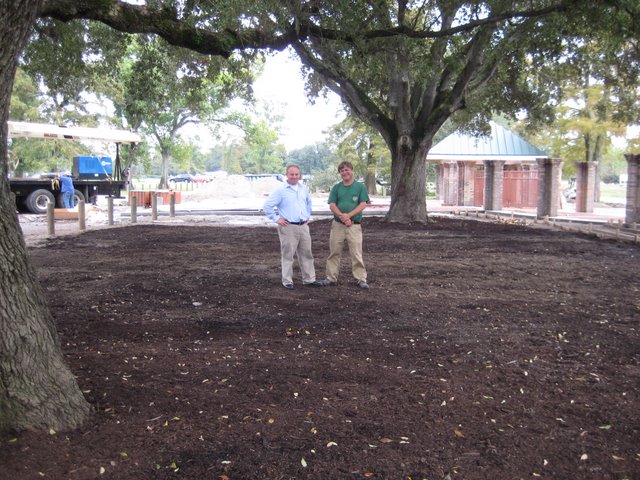
Newly hired LSU AgCenter horticultural agent Russell Harris (L) stands with La. Dept. of Agriculture & Forestry arborist Tom Campbell (R) under two live oaks where soil was aerated, remediated and improved at the new City Park Dog Park.
City Park’s consulting arborist, Tom Campbell, working with contract arborist Tom Benton, has taken the first step in best practices for live oaks with a soil remediation project for two trees at the site of the new dog park. This location, where cars parked for decades and compressed the soil, was a great candidate for the effort.
Working with what arborists call an “air knife” that injects compressed air into the soil, loosening it and allowing air, water and nutrients to flow, the soil was also amended with organic matter and now looks rich and life-giving.
The site will now serve as a test for future efforts. The next likely candidate area is the playground near the Peristyle, where years of human activity have compressed the soil and badly damaged many mature trees.
Kudos to Tom Campbell and City Park for taking the initiative to begin this much-needed process of restoration and best practices!
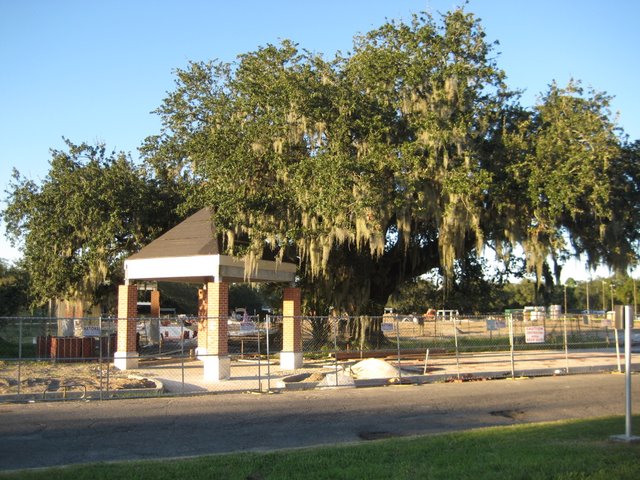
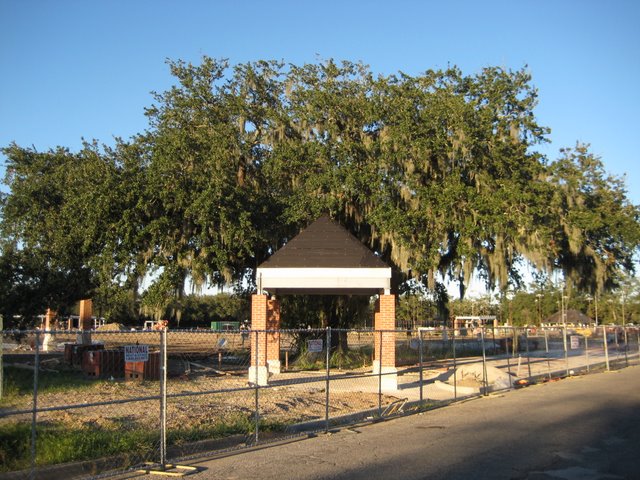
Just what every ancient live oak needs: a man-made building.
Thanks to Lolis Elie and the Times-Picayune for telling the story of how I’ve been trying to promote best practices for tree care in our area.
This is just a brief post for new visitors. I’ll be updating in greater detail later. But, I have to address a statement made by landscape architect Carlos Cashio in today’s article. He says that “sometimes you take risks to accomplish certain design elements.” My response is NO, YOU DO NOT TAKE RISKS WITH MATURE LIVE OAKS IN CITY PARK. Ever.
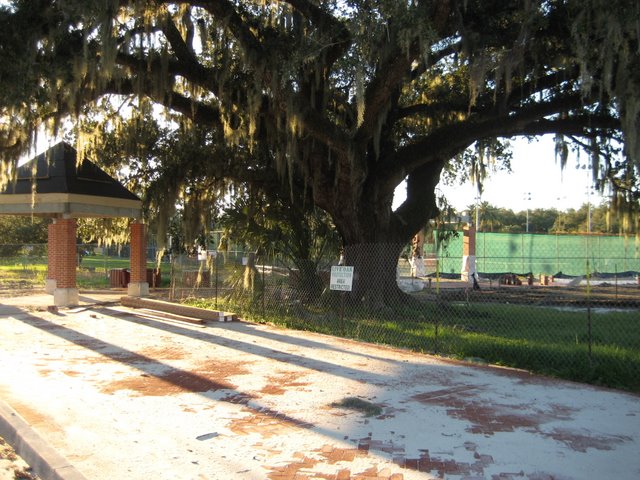
I post these pictures to let you decide for yourself. What is more beautiful: Carlos Cashio’s concrete and brick pyramid-hat building or God’s ancient live oak?
Architectural symmetry is more important to Cashio Cochran than the beauty of an older live oak.
It’s past time to let some of the true stewards and visionaries in the field of landscape architecture shape the future of this precious place. We already know what Cashio Cochran can do, and it does not meet my standards of the concept of legacy.
After I challenged this construction, sand was used under the brick rather than concrete. However, sand has little pore space to allow air, water and nutrients to reach the tree roots, so the tree will suffer so we can walk on bricks. Harming the oaks steals from the future and violates our history.
Geez, I wonder how many of the tragedies that befall us down here are going to happen in Iowa? They’ve flooded and know what it’s like to deal with FEMA. Now they’ve had corruption of their film tax credit program resulting in their economic development director’s resignation. Who could have imagined it? Corruption in a tax credit program involving the film business! Here’s one link to their story. And here’s another.
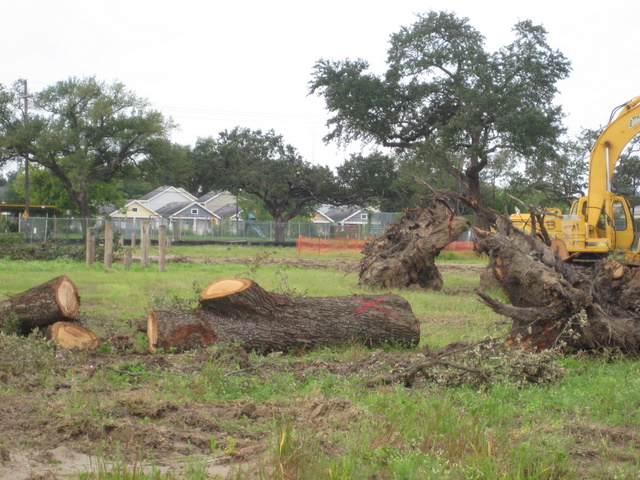
One of the more than 30 mature oaks destroyed by the redevelopment of the Lafitte Projects on Orleans Ave.
I really like the people behind the rebuilding of the Lafitte Projects. They’re nice. They said the new development will have many green and innovative features. But evidently everything must fit in nice square spaces and these trees are just not part of their vision for what the neighborhood should be.
30+ mature trees cut, 7 retained. And the beat goes on.
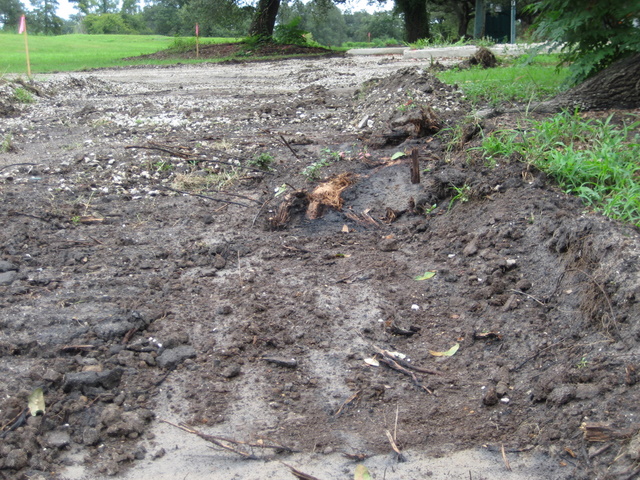
Bulldozed path under mature trees on Harrison Ave in City Park. Roots have been severed. These trees have been permanently damaged.
Good grief. I’m still trying to get to the bottom of this latest horrible development. Evidently the City of New Orleans bears some responsibility for restoring Harrison Ave through City Park. Not only are they widening the road–to the detriment of the oaks–but they’ve specified that a path be cut, evidently for sidewalks. Even the construction crew was surprised at the technical specifications which called for them to bulldoze the path. Now the trees have had their roots severed and are destined to be compacted and be abused by suffocating additions, likely concrete.
Why is it that as we rebuild we are killing so much of what matters in this town? What the floods didn’t take, stupidity is.
I couldn’t post all the pictures here so I built a Posterous page with 27 pictures. You can find it here at http://dyingoaks.posterous.com
Who is responsible for this latest crime against our quality of life?
Close-up of root damage next to a mature oak on Harrison Ave in City Park. This path was carved by a bulldozer to build a sidewalk where none existed before. Paths can be built without harm. Somebody screwed up big time.
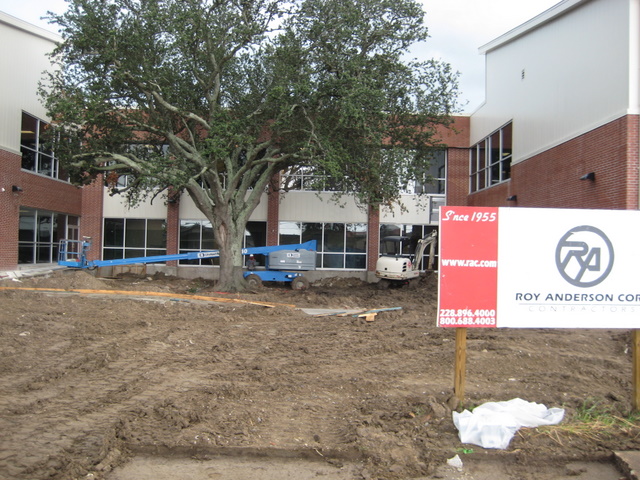
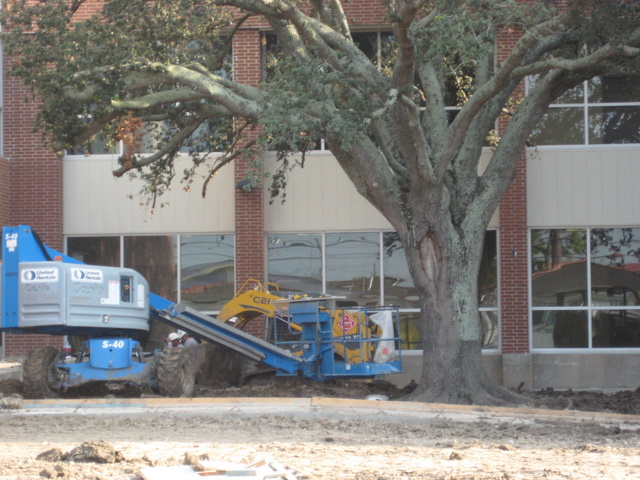
Live oak at new Langston Hughes School being damaged by heavy equipment
We are all excited that children in New Orleans soon will be walking the halls of beautiful new schools built to USGBC LEED standards. However, though the buildings may have been constructed to green standards, the actual green settings the schools sit within–the grounds, the trees, the soil–are being killed by the same old-style construction approach LEED for Schools attempts to change.
At Langston Hughes School on Trafalgar, a lone live oak was treated as the centerpiece by the Recovery School District design team. The physical structure was wrapped around the tree with the intent to create an iconic component of the campus.
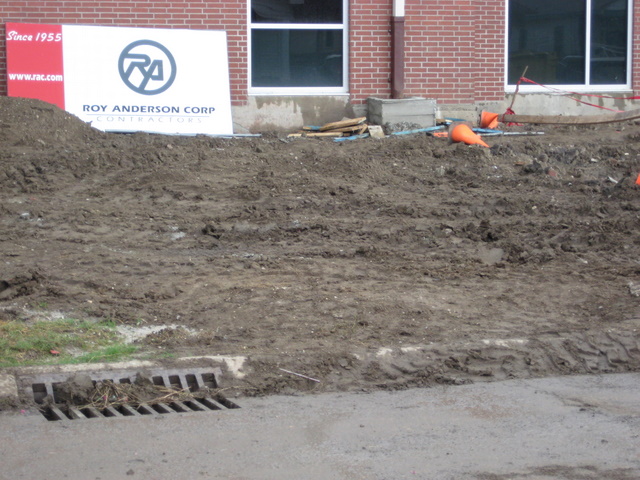
Over the past month the contractors, Roy Anderson Corp of Gulfport, Mississippi, lost their way on the path to green and let heavy equipment gouge and compact the soil around the already-stressed tree, dooming it to die-off in the coming months.
Tens of thousands of dollars, possibly more, were spent accommodating that live oak. And, in the final weeks of construction, RAC–in a rush to complete on time–turned the Hughes site into a pig sty of mush.
This is not the only messy school site with problems of runoff and soil degradation. Greater Gentilly High and Holy Cross High on Paris Avenue near the Lakefront are also messy, muddy, soil-damaged sites.
There is a pattern of site mismanagement happening around New Orleans as we rebuild. Despite federal and state regulations requiring the filing of a Storm Water Pollution Prevention Plan (SWPPP), one of the first permits needed when developing sites of more than one acre, none of the RSD schools, or former housing project sites, appear to have such plans and permits in place. A SWPPP is a site management plan for preventing runoff from construction activities to enter nearby storm drains. This is why you see silt fences and other creative filtration systems on construction sites. The aim is to reduce pollution and to prevent the clogging of vital storm drains and reduce flooding.
EPA and DEQ have strongly enforced rules in other areas of the state; but, they gave New Orleans a break because of Katrina. However, as evidenced by the lack of site management all over town, it’s long past time for them to pay a visit.
What’s really sad is that the major construction firms doing the most damage are very familiar with SWPPP plans because they adhere to them everywhere else. But, because EPA and DEQ haven’t been demanding compliance, these firms are skirting the laws, resulting in muddy sites that are clogging storm drains and adding pollution to area drainage systems, many of which flow into Lake Pontchartrain.
After sending emails with pictures to representatives of organizations involved in the RSD rebuilding, I’ve received no response and see no evidence of improvements. Thus, I again post pictures and words that I’d rather not. And after such a glowing story in last week’s paper, I am compelled to note that the Times-Picayune reporter evidently was blinded by the green glitz and didn’t see the green being killed under his feet.
Langston Hughes School was designed around this carelessly damaged by contractors live oak. Photo taken 8.6.09Contractors in the act of damaging Langston Hughes School's only mature tree. Aug. 6, 2009
Mud flowing into storm drain at Langston Hughes School August 5, 2009
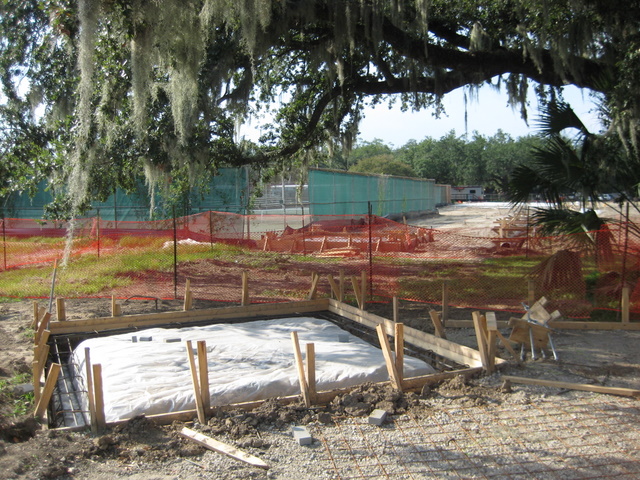
Stately City Park Oak damaged by construction to build concrete forms.
Special note: I want to apologize if this post ruffles feathers. I admit that I am frustrated. I feel like I’m watching a loved one being assaulted and I’m supposed to be diplomatic and say, “please stop hitting her.” I pray that I find the inner-peace, wisdom and tact to evolve into a more effective and less-pointed advocate for a better world. For now, however, this is what I’ve thrown out there to try to find “light in the darkness of insanity” to quote Nick Lowe. I only want the best for City Park and our precious Louisiana. SP
Here are the gory details:
Well paid City Park designers, contractors and staffers continue to abuse and kill the precious live oaks under their stewardship. The Great Lawn project, part of the park’s Master Plan, is currently under construction. Just as with the Pavillion of the Two Sisters, a project that killed nearly a half dozen trees with at least one still barely holding on; and, with the loss of trees in the Sculpture Garden ongoing, all due to bad planning and implementation that failed to properly protect the soil and delicate root systems of the trees, the park is in trouble.
As I said in a previous post, City Park is being paved over. Already, an acre has been slathered with a suffocating coat of toxic asphalt. The Master Plan calls for many more acres to be encased in life-starving, impermeable concrete and asphalt because too many people in charge don’t know readily available procedures for Best Management Practices for a public park.
As I’ve noted, New Orleans City Park should be the green heart of the area. It should be the leader in sustainability and green principles to which we all turn to learn about and witness how humans properly manage the natural spaces our parks represent. After witnessing the construction of the Big Lake project and it’s poor choice in materials, tree selection and placement, and water management strategies–which connect to all these issues–I believe the park is in the hands of people who are reshaping it in ways that reflect the mindset of a bygone and downright ignorant time.
Here’s a letter I sent today to several people involved in the operations and oversight of City Park:
Hello:
I am writing to urge you to act swiftly to prevent further damage to live oaks in the park; and, to add appropriate arborists and local green/sustainable design experts to the paid teams developing and implementing the park’s Master Plan.
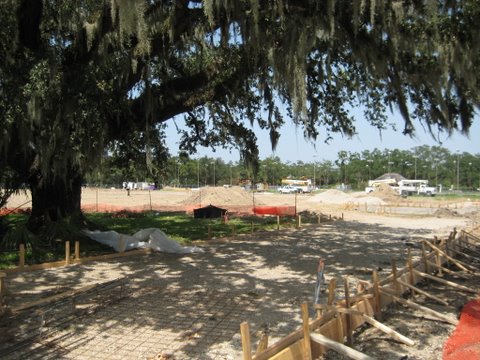
Apparently, the overall planner for the Great Lawn project designed it to include concrete structures around the base of the large live oak across from the Peristyle. The design does not take into account the needs of the tree. Damage is happening now, with large areas deep under the canopy dug-out, lined with gravel and framed for concrete. Additionally, there is a trenched square nearly a foot deep under the canopy, cut across the roots.
As a lifelong advocate for live oaks, a recently trained Parkway Partners/Louisiana Urban Forestry Council Certified Citizen Forester; and, having learned Best Management Practices at Jefferson Tree School, a continuing education program for arborists, I know that the top 18 inches of soil are the most critical to the health of live oaks. The photos show the “improvements” underway have removed the top layer of soil and deeply trenched a section, cutting vital roots.
This is clearly a case of destructive design and construction that should have been stopped at several stages of the process.
With the heat, drought and now root damage, this tree will suffer significant die-off from which it will never fully recover. I believe you should immediately bring in a local live oak expert such as Scott Courtright or Tom Campbell to evaluate and try to remediate the damage already done.
It is time for City Park to stop using impermeable hardscapes that suffocate the soil, kill the trees, increase flooding and erosion, and speed pollutants into our precious waterways. No more impermeable concrete or toxic asphalt!
In researching this situation I learned an important fact regarding landscape architects: their degree does not require them to be arborists.
To me, this explains many things regarding how and why trees have been damaged in City Park.
Trees seem to be chosen by the park’s go-to landscape architect with appearance superseding appropriateness. Paving systems are designed and built without an arborist’s understanding of their impact. This is not in line with Best Management Practices for native flora, water management, enhancement of the flyway and wildlife, or Low Impact Design. Any number of people in our area are experts on these matters. Some of them are cc’d in this email.
This is not a job for volunteers. Well paid contractors–using taxpayer funding and donations of people who assume we’re using BMPs–are currently creating these destructive actions. It’s past time to include paid local experts who can help the park become the green leader we all need and deserve.
Thank you for your prompt attention to this matter.
City Park oak damaged by trenching under canopy for concrete form.City Park oak being damaged by construction of concrete forms for Great Lawn project.Update on concrete form as of Thursday, August 6. Probably going to be some kind of iconic Great Lawn fixture or sign. So this oak is going to end up looking like an amputee as it dies-off thanks to this unbelievably stupid implementation of the design.
Ok, it’s time for me to re-visit a festering splinter. I apologize to readers who are bored with this subject. But here goes….
The basically non-existent Louisiana Music Commission (LMC), operating as a very minor component of Louisiana Economic Development (LED), continues to fail miserably at it’s mission “to promote and develop the popular, commercial music industry” in Louisiana (as per LA R.S. 25:315-317).
Of course there’s no budget specifically for music; and, with the state obsessed with Hollywood, chicken plants and sports, it’s no surprise that music continues to suffer.
As one of Louisiana’s signature natural assets–and one of the few industries here that continues to influence the world–this failure: to lead, to market, to support, and to recognize the importance of this irreplaceable and immeasurably valuable citizen-resource, is inexcusable.
The latest attempt to quantify Louisiana’s music resources reveals the depth of misunderstanding by economic development staffers, and represents another squandering of money on out of state “experts” who gather readily available data and then call it a study. Economics Research Associates in February released a state-funded report (anyone know the cost?) on Louisiana’s entertainment industry. It is a very revealing and, regarding music, deeply flawed document.
The music section begins with a lengthy overview (5 pages of 11) of the music industry using data readily available to anyone (even the LMC’s current director). The report then uses federal labor statistics and other industrial data to surmise that Louisiana’s business of music ranks well below 30+ other states, a patently ridiculous conclusion. And it is obvious that ERA did not fully understand, nor seek to document, the many facets of Louisiana’s unique music landscape.
What’s truly sad is that were the LMC fully funded and staffed with imaginative people, this study could’ve produced something worthwhile.
Back when we worked to gather this information, we used a combination of resources, including tourism data, staff researchers at LED, the Louisiana Music Directory and more. Since much of tourism is generated by music, that industry’s ups and downs are directly tied to music’s economic impact and contributed to our studies–this component was analyzed, by the way, by LED’s own highly qualified research staff. And, the only proper study ever done–by Dr. Tim Ryan of the University of New Orleans in the late 1980s–was not conducted by an out of state entity.
To continue to believe that only companies based out of state are capable of telling us who we are is a lingering problem in Baton Rouge and at LED.
The experts we need to help us analyze our music resources are readily available here in Louisiana. Utilizing this talent keeps money flowing between state government and higher education, helping to grow a new crop of experts and future businesspeople. In other words, it’s ECONOMIC DEVELOPMENT to first use your university resources to conduct studies.
Louisiana Economic Development fails at its mission when it fails to utilize readily available in-state resources within universities, nonprofits and businesses.
But I digress. When Ellis Marsalis, Bernie Cyrus and I were in charge of the LMC, we produced many reports on the state’s music industry. We posted these reports on the web for all to see. We distributed this information to the Office of the Governor and the Louisiana Legislature. And we determined that music’s impact on Louisiana was in the range of nearly $3 billion! Yet according to ERA, film is bigger than music in Louisiana. Really?
Of course Louisiana is spending more than $115,000,000 in cash money as tax credits to buy the friendship of the film industry here. And that money is giving lots of people work, many people from here–including some of my friends–and who knows how many from out of state. The data and the state’s “experts” have not quantified exactly how much of that money and those jobs stay in Louisiana.
But back to music, for that is our world renown, immeasurably valuable, historically significant, naturally occurring and most neglected asset. At a time when it is obvious that the recording industry is the component in the worst free-fall, both the state and ERA focused on the sound recording business as a measure, and as the only recipient of a little-used tax credit system.
Having done some of the earliest research of the state’s recording industry when this tax system was proposed–and kept out of the final drafts by a few nefarious folks, one of whom is headed to the pokey–I strongly believe that the current tax credit system is not what is truly needed. In my research–which involved me calling studio owners and asking them what their biggest problems were and what they though the state could do–I learned that studios sought sales tax relief and felt that the budget-oriented credits would both be little-used and have little effect.
ERA’s data certainly proves the little-used aspect, as only a handfull of projects have tapped into the credits. Of course the lack of staff at the LMC to process these credits is also partly to blame. But, as national data and the ERA report indicate–and anyone in the studio and music business can tell you for free–the recording industry is not doing well. Nevertheless, that segment is the focus of the state and of ERA.
The only apparent good news in the report is that music credits do better than film in the report’s cost-benefit analysis, supposedly generating $6.78 for every dollar in tax credits compared to $6.64 for film. However, since only $340,000 in spending was tallied for credits, the data says only a couple of jobs were generated. The study also notes that in 2008, $816,800 in productions applied for nearly $204,000 in credits. It’s encouraging to see the numbers rising. But it’s also frustrating to see the emphasis be only on this one aspect of the business. As a musician, I liken this approach to giving the cotton companies a tax credit during the waning days of slavery. What does this credit do for the musicians who are truly Louisiana’s musical gold?
Admittedly a few musicians have been hired to work on subsidized projects. And I don’t want to disparage the intention behind trying to support our vitally important recording studios, they need all the help they can get. But it’s almost like we’re subsidizing buggy manufacturers after the automobile was introduced. And studios, like every other aspect of music, won’t survive if musicians aren’t thriving.
Live music, which we determined in previous LMC reports has a multibillion dollar economic impact statewide, is given one short paragraph in the study–with no economic impact numbers. There are no inputs, no data, no charts, no information on taxes generated or jobs created in this live music paragraph.
Then the music aspect of the report ends. A total of 11 pages in a 90 page report.
There is no doubt that this report provides valuable data for state leaders. The study presents a very informative review of film incentives nationally. This will help people understand the landscape of film and media industry tax credits. And I’m sure this was the intent of all concerned in producing and funding this report. But, music is much bigger than this study says.
Louisiana music is a brand, unlike every other component of the report. And that brand has a worldwide value and recognition factor that needs to be tallied and supported.
The failure of the State of Louisiana–whether it is Louisiana Economic Development and/or the Lt. Governor’s Office of Tourism–to fully understand and support our vital music resources, isone of the great tragedies of mismanagement in the history of this state.
The power of our musical genres, of our music history and of our musical stars has never been fully or properly understood, valued, promoted or nurtured. What is even sadder is that everyone knows this and yet nothing substantial is done.
We convey an image to the world that our music matters. But it’s all just smoke and mirrors. We can do better.
Sidenote: Here’s a report we generated in 2002. It’s the kind of report that covers analysis of the industry both internationally and locally and includes all our projects, accomplishments and interactions for the year. Will the current LMC ever produce anything even remotely similar?
Smoking will take you places you've never been before.
In what is turning out to be one of the ugliest legislative sessions in my adult lifetime, the Louisiana Legislature seems bent on further eroding both our reputation and our wellbeing. After passing a bill requiring rear seat passengers to wear seatbelts, the leges kowtowed to the will of former governor–and mentor/benefactor of current Gov. Jindal– Mike Foster’s wishes and passed a bill that allows motorcyclists to go helmet-less, guaranteeing an increase in death and carnage–and higher medical bills that will cost taxpayers. Additionally, the House soundly defeated an attempt to ban smoking in bars and casinos, ostensibly to ensure freedom of choice. But that freedom only extends to smokers–a minority–and ensures that any nonsmokers–the majority–who wish to work in bars and casinos, or merely hear live music, drink a beer or gamble must breathe the toxic outgassing of smoking addicts.
Thanks, Louisiana Legislature! I’m no longer worried that my “right” to kill or maim myself or to personally pollute the air around me while smoking in confined spaces with nonsmokers will be taken away. Who cares that taxpayers will pay my bills if I smash my head in a minor motorcycle accident? And who cares if I make service workers sick or if nonsmokers don’t want to breathe my smoke? It’s freedom of choice–for me! I don’t want the government telling me what I can’t do to your lungs! That’s an invasion of my pursuit of happiness. So screw all you nonsmokers. How dare you use government to tell me what to do with your health!
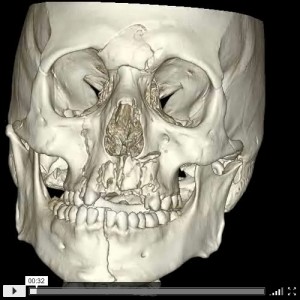
Actual skull damage after no-helmet motorcycle accident
Louisiana is truly a leader. We have 2 cities in the Top 10 for murder. We are the Number 1 per capita state for carbon emissions. We incarcerate a larger percentage of our population than any other state. And now we “protect” the “rights” of smokers and soon-to-be-brain-injured motorcyclists. Maybe we’ll become one of the top organ donor states when the helmet law becomes effective.
Just don’t get caught in the back seat without your seatbelt on. We wouldn’t want you to hurt yourself. Because we care about your wellbeing.
NOTE: As of 3pm June4, all 3 of these bills await final passage if any of you care to get involved and contact your elected officials. See the Comments for this posting for specifics.
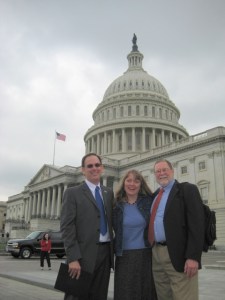
OK, I went to Washington and lobbied for S. 414, the Credit Card reform bill. Here’s what happened. We started the day at Sen. Mary Landrieu’s office, so I was up first. The staffer (I don’t recall his name but will update this when I get it) we met with was a bit cynical. I was disappointed. I tried to emphasize that the banks were harming Sen. Landrieu’s strongest supporters and that it was time for her to stand up for the poor people who vote for her. He basically dismissed that line of thinking since the next election is years away. He claimed that Sen. Landrieu wasn’t afraid of angering the bankers (not that we said anything like that, though she is the recipient of more than $2 million in banking lobby money) because she had supported a credit union bill vehemently opposed by banks. We tried to get him to admit the banks were screwing us with these rate hikes, fees and other onerous new burdens. But he never seemed to sympathize.
Next we met with Travis Johnson, a legislative assistant with Sen. David Vitter. We we engaged by a smart, civil staffer who challenged us, debated us and gave us an opportunity to rebut and refine our arguments. We might not have changed the way Vitter will vote. But we had an intelligent and satisfying discussion with his staffer.
We also visited with very receptive staffers in the offices of Virginia Senators Mark Warner and Jim Webb.
Despite the fact that Sen. Landrieu’s opposition might be enough to stop the bill, there is a sense of optimism that credit card reform will pass. We were promised that if there is a signing ceremony with President Obama, that we’d be invited back!
I’m grateful to Consumers Union and the Pew Charitable Trusts for this amazing opportunity. It was amazing to see how accessible our federal delegation is to visits. I would advise anyone seeking to be heard to take the time to visit Washington and make an appointment. A staffer will be assigned to meet with you and give you the chance to be heard. Whether they listen is another story all together. But the experience is worth it because if you don’t try, nothing is guaranteed to happen.
Please call Sen. Landrieu’s office at 202-224-5824 and Sen. Vitter at 202-224-4623 and tell them you support credit card reform and want the senators to support their constituents and rein in the banks. The vote could happen this week or early next week, so call ASAP!









 NOLAmotion Blog
You must be logged in to post a comment.