A Shiny Stadium, a Crumbling City: Why Opelousas Must Follow the Law Before Spending Another Dime

Despite extreme economic uncertainty and without following the legal requirements of the city charter, the City of Opelousas is well underway with plans to demolish historic facilities, cut large trees, and spend millions on a multipurpose community center and stadium upgrades in South Park. That charter mandates the appointment of a Parks & Recreation Commission to provide oversight, public input, and manage all spending and activities. Yet this legally required body has been unappointed since 2019, meaning all these funds flow without proper legal or community review.

While South Park is set to receive more than $12 million to support a select group of young athletes, the public librarya vital community asset serving all ages and abilities—is crumbling. Current plans call for the library to receive just $500,000—far short of what’s needed for a comprehensive renovation or new facility.

Why Not a Community Center in the Center of the Community?

Among the dozens of vacant buildings downtown is the former Bordelon Motors across from City Hall. That site could be purchased affordably and redeveloped for a combined library and true multipurpose center, serving not just recreation but as a resilience hubdisaster shelter, public meeting space, and business incubator. This would truly be a “monument to the people of Opelousas,” as the mayor described the stadium. Wherever it’s built, the center should focus on real public needs, rather than being another limited-use sports venue constructed without oversight and driven by whim, ego, and unfounded hopes. Besides, there is no shortage of gymnasiums or high-end sports complex dreams in the region. These are the kinds of ideas and questions a Parks & Recreation Commission and caring city leaders need to discuss, in public.

A Youth-Sports Model the City Can’t Afford

Nationally, only 6% of high school athletes ever play in college—and even fewer receive scholarships. Meanwhile, the mayor, the ODDD, park leadership, and Rep. Miller are backing a youth sports–driven, multimillion-dollar blueprint that tears down historic facilities and paves much of South Park in concrete and plastic “grass” in the guise of economic development, banking on expensive tournaments, hopeful revenue streams, and high-end, high-maintenance facilities.

But Opelousas, with its 34% poverty rate and shrinking population, cannot support that dream. As the falling birth rate statewide impacts enrollment, the St. Landry Parish School District currently faces an estimated $7.9 million deficit, underscoring the misplaced focus on funneling dwindling public dollars into sports infrastructure while neglecting students and families who need education, food, healthcare, and social support. And the glaring fact is that high school sports should be financed and managed by school systems, not cash-strapped city government.

The Unplanned, Ongoing Cost That Nobody’s Talking About

Despite questions raised years ago about these projects, the city has yet to share any calculations of the cost of long-term operations and maintenance (O&M) for these proposed projects, nor has it specified where the funding would come from to support this new, ongoing expense. With nearly 30% of city revenue at stake in the upcoming August 16 sales tax referendum, its failure will trigger a budgetary disaster that will undermine all of the city’s current and future responsibilities.

Although my household supports the renewal of the sales tax, its passage faces strong opposition. The mayor is far too quiet in gaining support for the tax, and has not published a plan for how the cuts would affect services and staffing. Whatever his response to a reduced budget will be, here’s what I conservatively calculated as potential, and new, annual costs to operate and maintain the center and stadium. The sad truth is that estimates like this have not been shared or reviewed publicly to understand their impact on the city’s budget. These are sobering numbers.

Multi-Purpose Center (>5,000 sq ft, metal building with soaring ceiling in dark metal cladding)

  • Cooling and utilities: ~$35K–$50K/year
  • Insurance: ~$25K–$40K/year (Louisiana’s rates are sky-high)
  • Staffing: ~$50K–$80K/year
  • Repairs/Maintenance: ~$15K–$25K/year
  • Supplies/Equipment: ~$5K–$10K/year

Total: ~$130K–$205K/year

Donald Gardner Stadium (post-upgrades)

  • Utilities (lighting, scoreboard): ~$25K–$35K/year
  • Insurance: ~$15K–$25K/year
  • Maintenance: ~$20K–$30K/year
  • Event staffing: ~$10K–$20K/year

Total: ~$70K–$110K/year

Combined Operations & Maintenance Costs

Annual Total: ~$200K–$315K

Over 10 years, that’s $2M–$3.15M, in addition to approximately $1.4M in interest on the bond debt borne by the ODDD.

These recurring costs have no dedicated revenue source and will compete directly with other essential services, including police, streets, libraries, and social programs.

Ignoring the Charter Equals Breaking the Law

South Park spending is being conducted without the city charter’s required oversight by the Parks & Recreation Commission, thereby violating both our city code and the public trust.

This isn’t simply cutting corners—it’s illegal.

We Can—And Must—Expect Better

This isn’t about being for or against parks. It’s about expecting:

  • Transparency in all park expenditures.
  • Appointment of the Parks & Recreation Commission—now.
  • Public hearings before approving major projects.
  • Priority funding for essentials: a safe, modern library; downtown revitalization; disaster resilience.
  • Publicly shared analysis of long-term operating costs for all proposed facilities.

If charter violations continue, I’m prepared to file a Writ of Mandamus (any Opelousas lawyers out there want to join me?) to compel legal compliance before a penny more is spent.

Take Action—Protect Our City’s Future

Things are happening quickly. Your voice matters. Contact your council member, the mayor’s office, the ODDD, and your neighbors and tell them:

Before any further demolition in South Park and spending on the multipurpose center happens, the mayor must appoint and seat the Parks & Recreation Commission, as required by law, to oversee his spending.”

We need compassionate, lawful leadership that utilizes science and community data to guide plans and spending. We expect our city leaders to do the right thing to represent us all, not carelessly spend based on the ego-driven “I want” of a few. Otherwise, Opelousas will continue to crumble and lose population, and people will wave at a shiny stadium as they leave for good.

Note: updated 8/12/25 to more accurately project bond interest based on the verbal monthly financial report given at the July ODDD meeting.
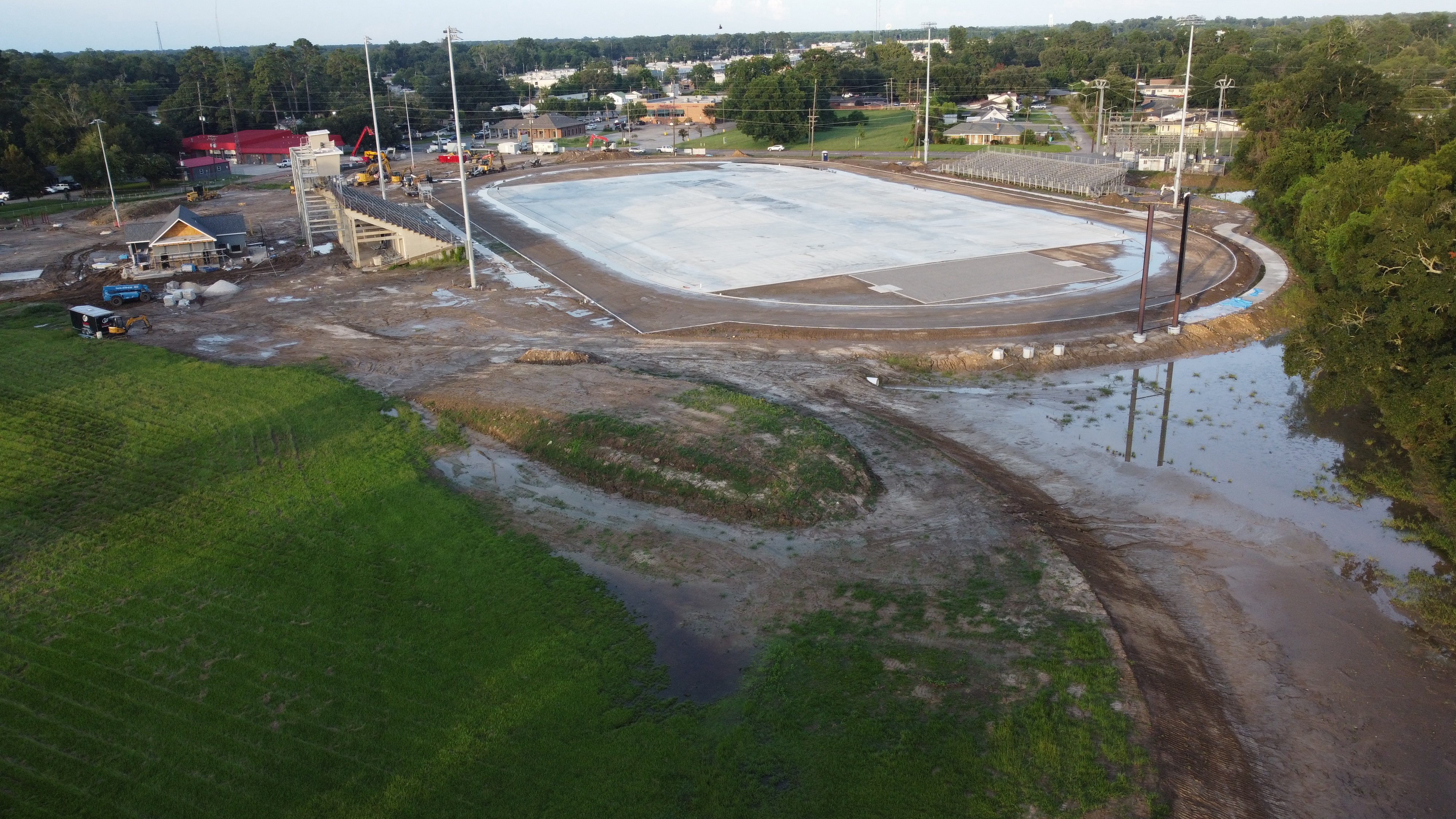
Concrete playing surface in place at Gardner Stadium, July 18, 2025. The end result is akin to playing tackle football on a parking lot covered by a thin layer of toxic plastic grass sprinkled with shredded tires.
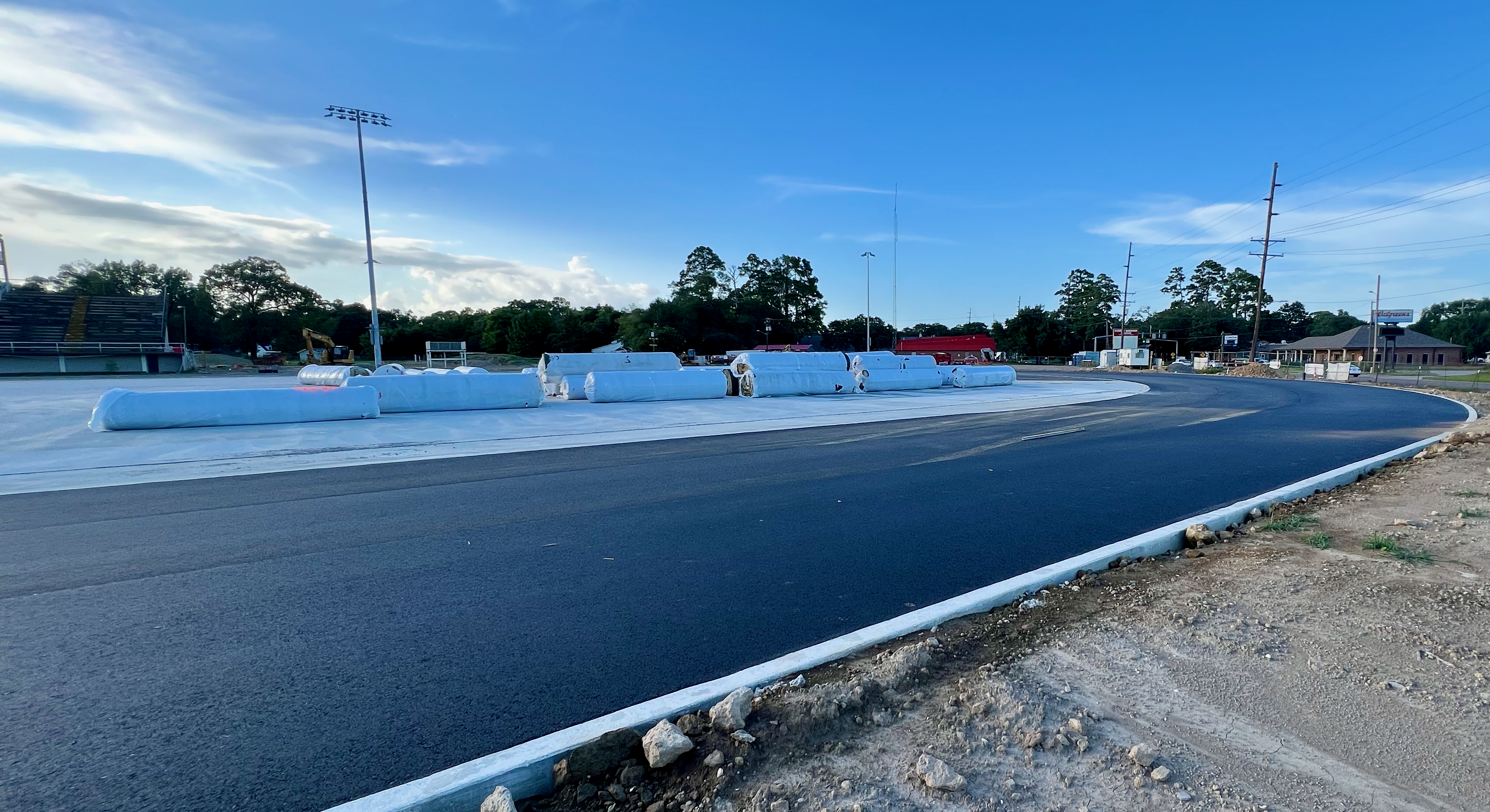
Black asphalt running track and rolls of plastic “turf” ready to be installed at Donald Gardner Stadium, July 27, 2025.

My Response to the May 10 “Statement from State Representative Dustin Miller (District 40)”

Yesterday, Rep. Dustin MIller released a statement on his Facebook page regarding funding for South City Park and other projects in Opelousas. The following is my reply.

We wish the South Park plans only cost the million dollars allocated from COVID relief funds. That would be reasonable and responsible. However, this is only a token of the full cost of this extravagant plan that you and a small group of insiders have developed without proper public input.

You state, “No local city government tax dollars are tied to the Donald Gardner Stadium improvements, the Community Center, or library renovations.” That’s misleading. Every dollar beyond the COVID funds comes from sales taxes paid by people who live, shop, and work in Opelousas. That is public money administered by local government. And if transparency is your goal, where is the full accounting of South Park spending—past, present, or proposed? To date, none has been provided.

The stadium renovation alone is projected to exceed $10 million, primarily funded by the Opelousas Downtown Development District (ODDD) through an additional one-cent sales tax collected at big-box stores. The ODDD issued municipal bonds to finance this, locking us into 15 years of debt, plus nearly $2 million in interest and fees, costs that are omitted from public statements. And if transparency matters, why are these decisions being made without the legally required oversight of a Parks and Recreation Commission, which the mayor has failed to appoint since 2019?

Then there’s the choice of location. The community center is planned for the site of the WPA-era pool—an area that requires destroying popular greenspace, major construction demolition, and subsequent fill that must meet engineering standards, all costly and unnecessary when vacant land is available nearby at a fraction of the cost.

Here’s an idea: Why not build the community center in the center of the community, where it could anchor downtown revitalization and support library programming? That’s the kind of impactful investment the ODDD is supposed to be making.

Meanwhile, the project lacks even the most basic financial planning. No published operations or maintenance budgets exist for the stadium or the proposed community center. Who will pay for utilities, insurance, staffing, janitorial services, or long-term upkeep? Artificial turf fields require specialized maintenance equipment and must be replaced every 6–10 years, at over $1 million per replacement cycle. Where is that money coming from?

Other communities have learned the hard way: these facilities are expensive and rarely break even. The original private funder walked away from nearby Pelican Park because annual costs were too high. That should be a cautionary tale, not a model.

All this unfolds while the city teeters on the edge of a fiscal cliff. On May 31, Opelousas will lose the source of 29% of its annual revenue due to the overlooked expiration of a long-standing one-cent sales tax. At the same time, our core infrastructure is in crisis. After this week’s rains, raw sewage is spewing from manholes, flowing onto residential streets, and into waterways that empty into the Vermilion River. Brown water continues to pour from our taps. Experts estimate that repairing our water systems alone will take $20–30 million. Securing funding for those repairs should be everyone’s top priority, because we are one incident away from a significant public health crisis. 

Yet, your focus—and the ODDD’s—has remained fixed on a flashy, limited-use stadium and recreation complex, not the urgent needs of a city with crumbling infrastructure, an aging population, and one of the highest poverty rates in the nation.

This isn’t just poor fiscal management—it’s misfeasance.

If you want the public’s trust, stop issuing misleading statements that justify these lavish and poorly researched plans. Opelousas needs investment in water, streets, housing, and jobs, not in distractions dressed up as progress.

Lavish Dreams, Empty Coffers: A Reckoning in Opelousas

By Stephen C. Picou (May 1, 2025) For over a generation, Opelousas has relied on a one-cent sales tax to fund nearly a third of its annual operating budget. That tax expires on May 31, 2025, and reinstatement requires a yet-to-be-scheduled public vote. This week, the mayor called for a special meeting of the City Council to continue public notice in support of a ballot initiative to renew the tax. But it’s a classic scenario of too little, too late to stop the cut, because this situation should have been addressed years ago.

How did we end up in this position? It’s not complicated. All city leaders had to do was read the Legislative Auditor’s annual financial report, which plainly states that the tax will expire in 2025. However, those entrusted to plan responsibly repeatedly overlooked this fact.

Over the past fifteen years, under the heading of Sales and Use Tax, the audit shared the following: “Proceeds of the 1% sales and use tax was initially levied by authority of a special election held on April 5, 1975, and was extended through May 31, 2025.” This statement does not hide in footnotes or small print; it is part of the main body of the report. Yet, until March of this year, no one at City Hall flagged it as an urgent concern.

One glaring reason for this oversight is clear: for the past three years, city leaders have been consumed by an ambitious and costly plan to transform serene and bucolic South City Park into a busy, commercially supported, paved-over, high-end sports complex. Fueled by city funds and special sales tax revenue from the Opelousas Downtown Development District (ODDD), this project became their fixation, while more pressing fiscal responsibilities were neglected. 

Some of us expressed serious concerns early on, warning that the plan was overpriced, poorly justified, and pushed forward with little transparency or public input. Instead of addressing our concerns, officials dismissed them—and us.

In November, as it became clear that substantial cuts to federal funding for social safety nets were imminent and could devastate Opelousas, the mayor rejected calls to prepare the city by reducing costs on South Park initiatives. He insisted on “staying the course” with the extravagant park development plans, the most expensive non-infrastructure project in the 300-year history of Opelousas.

In the days leading up to Mardi Gras, someone—whose identity remains unknown—must have finally reviewed the annual Louisiana Legislative Auditor report on the city’s finances and discovered the impending May 31 fiscal cliff. It wasn’t until April that the council could initiate the required public notice period.

When the tax expires on May 31, potentially severe cuts will soon follow. Who and what might be on the chopping block are issues that have yet to be discussed publicly.

Though I, too, was unaware of the looming expiration, my advocacy for fiscal prudence during these trying times was timely but insufficient. My analysis, rooted in extensive experience in government, community planning and outreach, economic development, and support for public parks and the environment, was that the city could not afford the costly plans for South Park, and that expenses to improve Gardner Stadium could easily be reduced by more than half while still meeting the needs of the schools.

For more than a year, I politely and professionally presented my questions and observations to the ODDD month after month. Initially, I was ignored. However, in recent months, as I uncovered and revealed details they kept from the public, I have faced scorn and derision. Last month, during an outdoor public event, a board member yelled at me, calling me negative, a liar, and an asshole, in front of city managers who chuckled like schoolyard bullies. I found the incident disheartening and unacceptable. That board member should resign or be removed.

Louisiana has the second-worst poverty rate in the continental US, exceeding eighteen percent. Nearly a million residents live below the poverty line. In Opelousas, the poverty rate is thirty-four percent, and in one Census Tract, home to more than 4000 people, the rate surpasses fifty percent. South Park is not in that tract; the much-neglected North Park is.

Due to special taxing districts like the ODDD, Opelousas has one of the highest sales tax rates in the country. The ODDD is mismanaging this revenue along with its responsibilities. They meet far from downtown at a location outside their district and operate with insufficient transparency and inadequate public input. Millions are being funneled into South Park without the legally mandated guidance of the still-unappointed Parks and Recreation Commission. What has transpired over the past few years, while they and the mayor were distracted by their envy and ambitions for a high-end sports complex like the one in much wealthier and fast-growing Youngsville, is nothing short of a travesty.

In his second term, the mayor is responsible for this situation and for failing to read the annual reports that clearly outline the pending sales tax expiration. Unfortunately, the phrase “the buck stops here” has taken on a new and painful meaning in his case. The bucks are stopping. What happens next is unclear, but we will all suffer due to the failure to prioritize investment in the basic functions of this needy, crumbling town. 

People in Opelousas are not clamoring for pickleball; they need food, affordable housing, clean water, good schools, healthcare, and job opportunities. Building state-of-the-art, limited-use sports facilities in a poor town with crumbling infrastructure, rather than investing in infrastructure and business development, is like putting a fur coat on a starving person dying of heat stroke.

Opelousas is a unique and special place. Our history, cultural mix, and location make it a desirable place to live. With the right infrastructure investment and leadership mix, this city can be a great place. However, this can only be achieved when the people elect city (and parish) leaders who strive for greater transparency, are guided by science and data, follow the law, read the audits, and incorporate the public’s voice. It’s up to all of us to do better! 

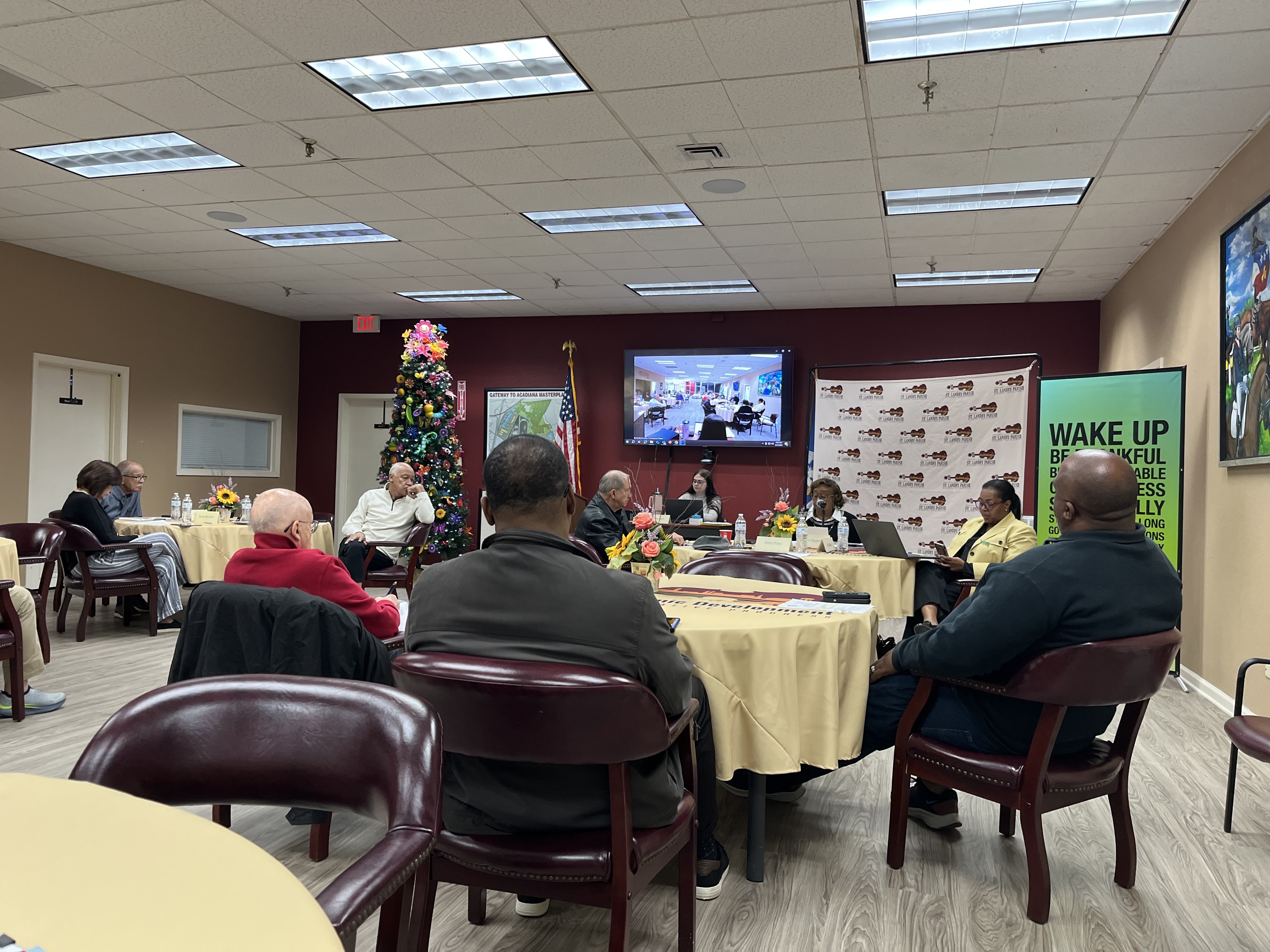
March 21, 2025, meeting of the Opelousas Downtown Development District. Held on the last Friday of the month at 9 am, outside the ODDD boundaries in the offices of the St. Landry Economic Development District (SLEDD), in the old Daily World building on the I-49 service road, nearly three miles by car from downtown.

The City of Opelousas Faces a Grim, Self-inflicted Fiscal Crisis

Our modest household pays a paltry twenty-nine cents a day in property taxes for the privilege of owning a home in Opelousas. Before we moved here, we paid $4.56 a day in New Orleans, nearly sixteen times more. In 2023, city leaders proposed a significant millage increase to fund infrastructure and transform their ability to deliver badly needed services. It would’ve raised our cost of living here to a still-low $1.16 a day. However, it faced externally funded anti-tax opposition and an apathetic electorate and failed by 250 votes.

Nevertheless, the city continued with its expensive plans to use bond debt financing to construct limited-use, artificial turf high school sports fields in its loveliest public park. We’ve been trying for more than a year to help city leaders grasp the folly of the scale of these plans.

But it gets worse, much worse.

On March 3, the Monday before Mardi Gras, the mayor’s office abruptly called (and then canceled) a special meeting of the council as part of an effort to provide a legally required public notice for something none of us saw coming—a one-cent sales tax that provides what I estimate to be $5 million, or nearly a quarter of the city’s annual budget, expires in May 2025 and requires a vote of the people for renewal. That this fact was not made public sooner is a painfully big question. But we are where we are, and a successful vote for renewal, now scheduled for July, seems a long shot.

If the city loses the referendum, a quarter of its $20 million annual budget will disappear. In fact, since the tax officially expires in May, that loss will already be underway.

The lack of news and information regarding this looming fiscal disaster is disturbing. And one can only hope the administration will launch a strong campaign to raise awareness and support. But if the headwinds against the millage are any indication, convincing the poor people of this town to tax themselves on everyday purchases when the state is already doing so without their vote, is a longshot.

On March 11, the day of the regularly scheduled council meeting, I sent an email to city leaders in Opelousas. I received no reply. This is what I said:

To the Mayor and City Council:

I believe in the future of Opelousas. We all need to do our parts for that future to be bright.

We won’t always agree, but if you act transparently and with assertive outreach and public participation, we can help this city thrive together. 

I also know that if citizens like me don’t shout “Look out!” when we see you driving off a cliff, we’re as responsible as you when things go wrong.

The extravagant plans for South Park are a fiscal cliff, and the car is speeding without enough hands on the wheel. 

I realize that the mayor and ODDD have invested substantial time and money, and feel like we must stay the course. You’re trapped in the classic sunk cost fallacy. But if (when?) the sales tax referendum fails, investing millions in a limited-use, high school sports stadium and track could be a fatal blow to the city’s finances and threaten our future. 

Nothing about this stadium project meets the criteria of good governance. As I explained in a prior email, the design is a toxic, injury-inducing threat to the health and well-being of the young athletes it’s meant to serve and the surrounding neighborhoods and watershed. It will produce adverse health outcomes, the opposite of what you all want to see happen. 

I’m sorry to write that, but as a lifelong public servant and activist for public participation and good government, I feel qualified to tell you. 

There have been no proper public hearings or input, no transparency, and no clamor by the public for this investment. In fact, the vast majority of people we’ve encountered oppose this project and see it as at the expense of improving our water systems and roads. This perception runs deep and will fuel opposition to the sales tax renewal.

South Park plans are the most significant non-infrastructure investment in the city’s 300-year history. Yet that expenditure only benefits a tiny fraction of the general population of Opelousas. 

As a poor town, we cannot afford to overspend on South Park or anything else, as the chaos in Washington, DC, continues to shake the foundations of our government, education systems, healthcare, and social safety nets. Cuts to the Department of Education combined with Louisana’s new voucher program will seriously undermine OHS and its ability to have strong athletic programming.

Even the anticipated construction costs are now in jeopardy as the price of aluminum is up 70% since January, thanks to tariff threats. With the additional interests and costs of bonds, the final bill for the stadium will easily exceed ten million dollars. And without feasibility studies to determine demand, income potential, operational costs, insurance, and maintenance, we’re wearing blinders as we head for the cliff. 

In addition to the lack of adherence to good governance, legal questions arise due to fundamental gaps in how the city is supposed to operate. These questions could open the city to undesired scrutiny and meddling by politically opposed factions.

The City of Opelousas has not had an appointed Parks and Recreation Commission since 2019, despite its legal mandate to oversee all aspects of park management. Without this oversight, current plans lack the transparency and due process required for significant public investments.

The solution is for the City to immediately reappoint the Parks and Recreation Commission to ensure transparent and lawful oversight of all park-related projects.

The mission of the ODDD is to foster commercial growth and economic revitalization downtown. Investing millions in a limited-use high school sports facility—particularly one that may not be accessible to the general public—raises questions about how such an expense aligns with the district’s goals.

As a concerned citizen, I expect all public funds to be used in a manner that is transparent, legally sound, and beneficial to the entire community. The City risks potential litigation, financial mismanagement, and public backlash without a clear legal basis for this expenditure.

It gives me no pleasure to call you all out on this situation. But here we are. It’s not too late to scale back the stadium plans to save millions of dollars and still have an above-average football facility. 

The people of Opelousas need and deserve a city that serves everyone by first providing public safety, dependable infrastructure, and clean water. Without transparency, outreach, and public participation, you will not successfully deliver on that responsibility. You have the power to steer us in a better direction. And it starts with reigning in extravagant spending. 

We’re all in this together. Thank you for your public service! Please do better! How can I help?

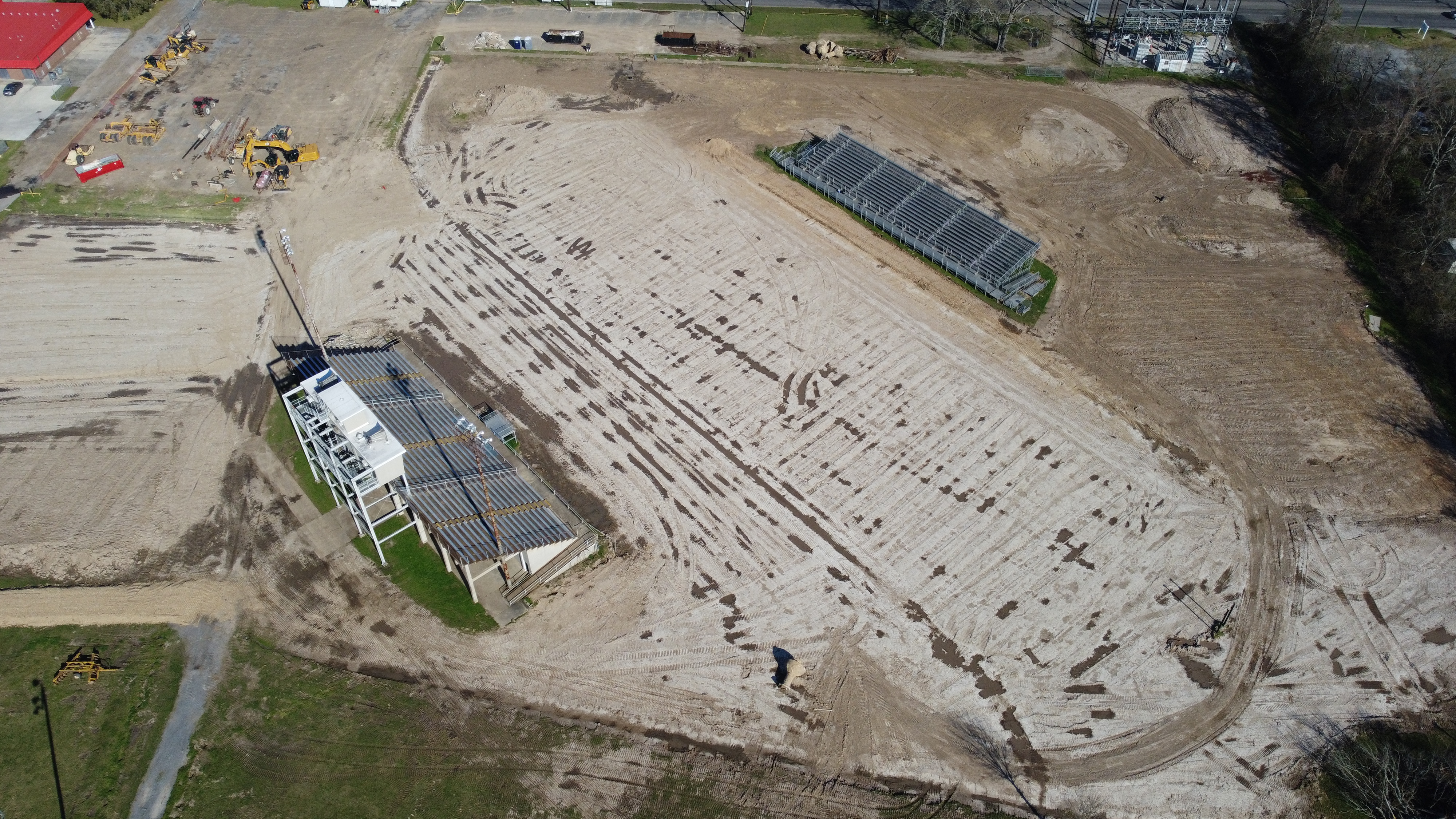
Construction at Gardner Stadium in Opelousas, a facility that serves two of the city’s five (!) high schools. The largest non-infrastructure public investment in the city’s history, estimated to cost more than $10 million. As seen on March 10, 2025

Louisiana Tax Structure Fails Our Education Systems and Threatens Our Economic Future

The repeal of the Stelly Plan that removed certain sales taxes on food and other items and created a more balanced income tax structure is causing a much-predicted crisis in Louisiana. We are facing the worst funding shortage in memory. And cuts announced this week to higher education are going to devastate our universities.

When the Stelly Plan, which voters approved, was ceremoniously repealed, we ended up with two tax cuts. And these cuts are not stimulating our economy, they are causing layoffs, higher tuition and myriad problems that will harm the reputation of Louisiana and that threaten our economic future.

When the Stelly Plan was repealed, we didn’t return to the status quo–we just gave a tax cut to the upper brackets and didn’t replace the funds from the removal of the sales taxes.

Stelly was a fair plan. The sales taxes that hurt poor and middle class residents were lightened and we all paid a few dollars more (at least those of us at average income levels, in my case it added less than $100) in income tax. It worked. Now we’re in a pickle. And it’s not even because of some lousy Friedman-esque economic theory–it’s because of political grandstanding and misrepresentation of how taxes work.

Those who want Louisiana to prosper, to have a solid education system, to have better roads, safe and secure drinking water, fair and honest police, fire and emergency service systems, courts that dispense justice and are able to put people in facilities that securely and effectively incarcerate without breeding more crime (or being complete hellholes where you may die within hours whether guilty or not) must pay for these things. That’s what taxes are for. And with federal prosecutors hot on the tails of corruption (thanks in no small way to the fact that all contracts now end up on computers and leave multiple electronic trails), things ARE changing for the better.

But we have to demand vision and leadership from our elected officials, not platitudes and phony political philosophy. And we have to do our parts to participate, to go to meetings, to be watchdogs, to volunteer to help our city halls and parish services, and to vote.

These problems are not going to be solved by name-calling rallies or by shouting down political discourse when our elected officials have public meetings or by calling fellow citizens socialists because we disagree with them. Democracy is hard work. And we in New Orleans have gotten better at it than most of the country. But now we need the rest of Louisiana, the average citizens (not just business and political leaders), to get on the ball and participate.

It took a massive (and man-made) disaster to make us in NOLA get involved. Is that what it’s going to take for the rest of the state to get with it?