The Financial Cliff: Why Opelousas City Government Can’t Afford a 17,000 Square Foot Gymnasium

Design Failures, Federal Noncompliance Liabilities, and the Fiscal Reality We Can’t Ignore

Opelousas stands at the edge of a financial cliff. It’s not a metaphor. Between the city’s $1.85 million loss of sales tax revenue (updated 11-17 after City Council meeting), historic cuts to federal food assistance, inflation, rising insurance and housing costs, and a destructive federal shutdown, the economic floor is crumbling beneath our feet. This isn’t a short-term squeeze. It’s a systemic threat to the city’s future—and it’s being ignored in favor of ongoing, unaffordable vanity projects in South City Park.

The next step toward the financial cliff is the proposed “community center” now being hastily pushed forward without full public input, transparent financial planning, or credible alignment with its federal funding source. It stands as a symbol of bad planning, mediocre design, and poor governance. 

What was originally a 17,000-square-foot double gymnasium in the South Park Conceptual Master Plan for a sports complex was quickly rebranded as a multi-use community resilience center to comply with the federal Capital Projects Fund (CPF) guidelines.1 These guidelines require the facility to offer a variety of services and flexible spaces for technology access and community programming, all of which must be provided free of charge to the public. 

Federal CPF requirements emphasize digital equity and community technology access, but the current design lacks structured wiring, IT closets, or dedicated broadband access areas. There is also no indication that co-working, telehealth, or digital literacy spaces are included in the interior layout. Additionally, the application to the state fund manager depends on loosely verified claims of public-private partnerships to justify the grant. 

Federal funds like CPF are a bureaucratic minefield that only the hardiest of administrators handle well. At this week’s ODDD meeting, the paid lobbyist working on the project admitted they’ve been meeting weekly with the state to revise five sections of the application to meet US Treasury requirements, including design features and the production and proper retention of required support and verification documents.

Having experienced the floods and losses of Hurricane Katrina firsthand, I understand how challenging federal compliance can be. The scariest scenario is that if a failure or compliance violation is discovered after the center is built, the city could be responsible for repaying the funds. Given our history, it’s wise to assume this is a real risk going forward.

Despite being designed for sports, there are no showers, lockers, changing rooms, or much storage for equipment. Yet the city and ODDD believe this facility will attract travel league and other tournaments. With such significant design gaps, how can this building compete for tournaments when it lacks features every school gymnasium has? Since no unbiased research was conducted, no one truly knows if this facility could attract paying users. 

The project’s other design flaws are more than just cosmetic and will increase operational costs and expenses that were not estimated during the initial planning. Failure to specify high-efficiency HVAC systems and design, and using dark metal cladding in a hot climate like South Louisiana, will increase energy bills, strain long-term maintenance budgets, and weaken claims of environmental or financial sustainability. 

The plans also lack site-specific stormwater management features, even though the park is vulnerable to erosion when runoff drains toward Bayou Tesson. The building will generate nearly two acre-feet (more than 650,000 gallons) of runoff annually, yet features no window awnings, no rainwater buffers, and no designs that integrate the building’s voluminous runoff into the (mostly clogged) existing drainage system in ways that won’t overwhelm nearby streets and neighbors.

These choices reflect the same disregard that has defined this administration’s handling of parks, planning, and public trust: no Parks & Recreation Commission, no community workshops, no unbiased research, no cost-benefit analysis, and no meaningful space for public voice. Instead, the process has been top-down, opaque, and dismissive—a local government acting more like an autocracy than a steward of public dollars.

This isn’t just about bad design. It’s also about federal compliance and failures that could come back to haunt the city even after the money is spent. Based on federal rules outlined in 2 CFR Part 200 and Capital Projects Fund guidelines, this project likely fails to meet minimum standards for cost reasonableness, historic preservation, public input, and sustainability. It may also run afoul of Section 106 of the National Historic Preservation Act, given the landmark WPA bathhouse and pool slated for demolition.

Because federal funding requires most usage to be free, how will the city cover operational and maintenance costs, which are likely to exceed $100,000 a year (excluding staffing) and put further pressure on the budget?

This isn’t resilience or good governance. It’s a retreat from reality, the public, and financial responsibility.

In these increasingly challenging times, leadership involves more than ribbon-cuttings. It requires a commitment to truth, transparency, and long-term community well-being, with a priority of making Opelousas a well-managed place where people want to live. As I’ve stated before, too many of the individuals behind these costly plans do not reside here, and some of them are among the city’s and parish’s highest-paid employees. Is it too much to ask that we all share a vision of Opelousas as a place where people want to live, and let that guide us? 

Before another dollar is spent, this project must be reevaluated for compliance, relocated to a more appropriate and less destructive site, redesigned for efficiency, affordability, and sustainability, and re-grounded in the public interest it claims to serve.

Because the only thing worse than walking blindly off a cliff is dragging a city with you.

The footnote below is the language of (and links to) the US Treasury Department that describes what funds can be used for. Note that the pictures are screenshots from the public bid documents, which were not posted on the city’s Advertisements for Bids page. Like the South Park plans, the bid docs remain missing from the city’s website. These plans and this spending are being done without the legally mandated oversight of the yet-to-be-appointed by the mayor Parks & Recreation Commission. The construction bid proposals are due and will be opened at City Hall on October 30 at 2pm.

  1. Multi-Purpose Community Facility Projects: the construction or improvement of buildings designed to jointly and directly enable work, education, and health monitoring located in communities with critical need for the project. ↩︎
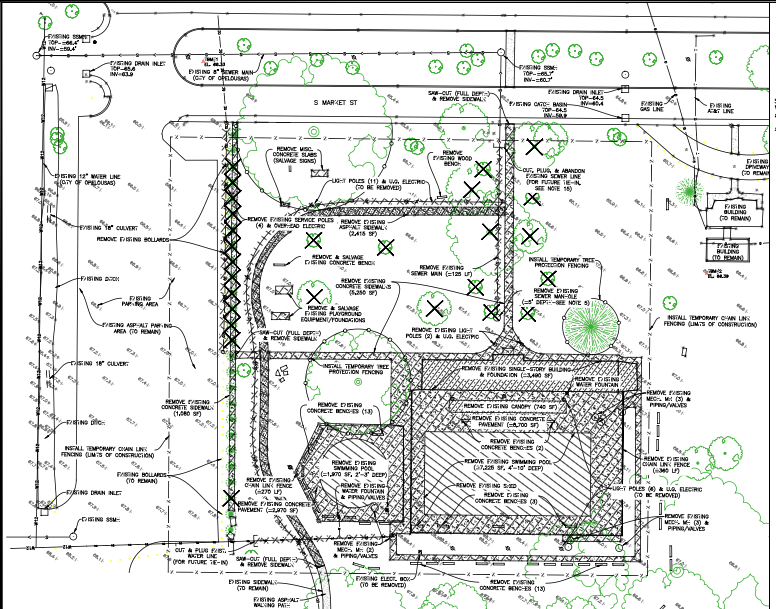
Site plan from public bid construction manual. Every X is a tree or shrub to be cut. Note the entire pool complex is set to be “removed” and the walking path re-routed.
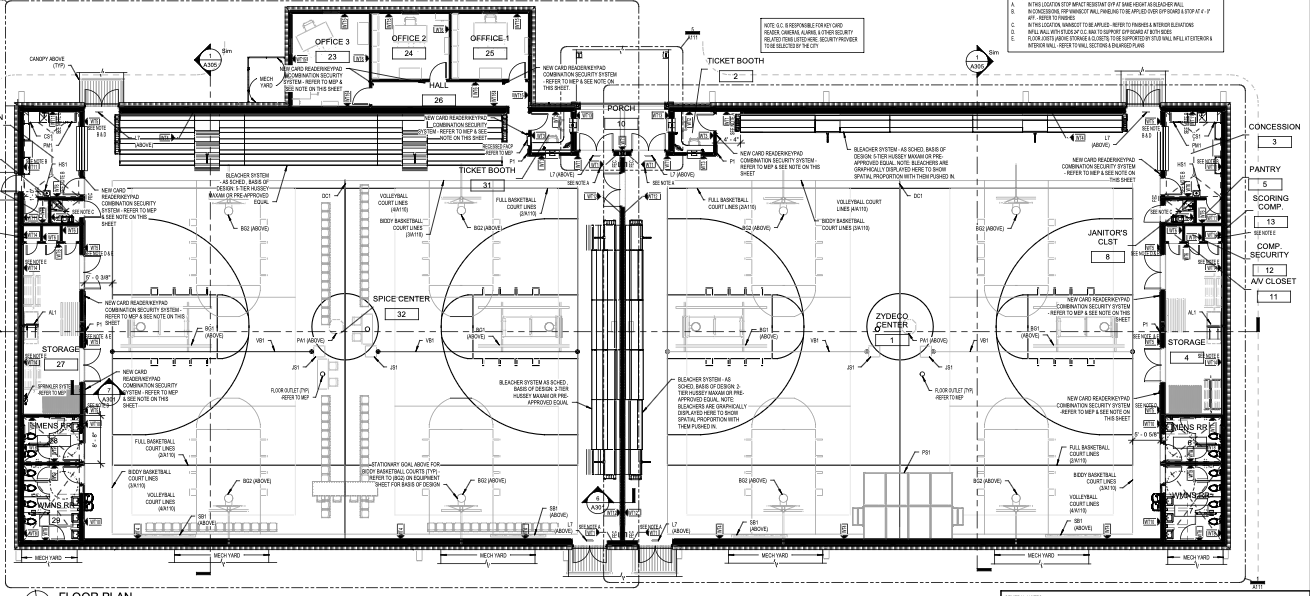
Floor plan from the public bid construction manual. Note the lack of lockers, showers, and storage. The bathrooms are small and there are no designated flexible areas to comply with federal guidelines that the building accommodate “work, education, and health monitoring.” It’s a gym, and lacks the functionality and flexibility of most school gyms, making its use for tournaments questionable.

The Real Game in Opelousas Isn’t Football — It’s Accountability

A Letter to the Opelousas City Council Regarding the Absence of a Parks & Recreation Commission, October 14, 2025

Councilman Gilbeaux (and Colleagues):

Thank you for raising the issue of the absence of a Parks & Recreation Commission at the last Council meeting. You were right to bring it forward. A functioning Commission is not a formality—it’s the mechanism that ensures fairness, transparency, and public participation in decisions that affect every neighborhood and age group.

Today, Opelousas faces difficult choices. The new 17,000-square-foot “community center,” essentially a two-court gym, will add substantial operating and maintenance costs to the city’s strapped budget, on top of the new stadium’s ten-year $632,000 annual bond payment. Together, those facilities could approach $900,000–$1 million in yearly obligations—before staffing or programming. And the timing couldn’t be much worse.

With the shutdown of the federal government well underway, Opelousas will suffer disproportionately compared to wealthier communities, making the ongoing capital investments in youth sports facilities, in an era of declining birth rates and enrollment, doubly troubling. Never before has citizen participation and oversight been more necessary. Here are conservative figures for you to ponder as you work to manage the city’s shaky budget:

IndicatorEstimateNotes
Population15,7502023 Census Data
Opelousas Median Household Income$28,000LA median $60,000, St Landry $42,000, US $80,000,
Poverty Rate35%Among highest in Louisiana
Percent of households under $30,00060%Most citizens are barely getting by
Renter Households57%Majority are cost-burdened
FY 2025 Budget Gap$1.4m to $2m 4 months of sales-tax shortfall
Stadium & Track Bond$632,000 / year10-year ODDD obligation
Total New O&M Burden≈ $900k–$1M / yearDebt + maintenance

Feeding families is economic development. The shutdown is already significantly impacting local food security and the local economy. Loss of SNAP and WIC dollars will exacerbate hunger, hurt local grocers, and shrink tax revenues. If the shutdown lingers, the impacts will be grave. Using conservative estimates of the number of people using SNAP and WIC, here’s how that looks:

Federal Nutrition Program Impact on Opelousas

ProgramEstimated Beneficiaries (City)Monthly Local Spending Loss in Local Economy6-Month Shutdown LossTotal Economic Activity Lost¹
SNAP≈ 4,500 individuals, 30% of the population (~1,700 Households)≈ $550,000 or under $125 per month per recipient≈ $3.3M≈ $5–6M
WIC≈ 2,000–2,500 participants≈ $250,000≈ $1.5M≈ $2.5–3M
¹Every $1 in benefits generates roughly $1.50–$1.80 in total local economic activity. Combined potential 6-month loss: ≈ $7–9 million—comparable to one full year of Opelousas’s sales-tax receipts.

An expensive-to-maintain and operate high school football and track stadium, along with an oversized basketball gymnasium, destabilizes our fragile economy and faltering budget. Paving South Park to transform it into a high-end limited-use sports complex will not cause anyone to stay here or to move here. Dependable infrastructure, clean water, good housing, and economic opportunities are what drive quality of life. 

Every dollar spent on South Park sports plans is a dollar not available to invest in youth development in life-skills programs, tutoring, trades apprenticeships, or arts, music, and culinary education, which often have higher “bang-for-buck” in communities where children lack access. And who can afford the $20 ticket price collected at last week’s games? Are projections (if they exist) based on potential ticket revenue? 

The ODDD, formed as a business development organization, mortgaged a decade’s worth of sales tax revenue, accruing more than a million dollars in interest and limiting the city’s ability to fund programs essential for building economic resilience and a better future for all Opelousas citizens. I call them the Opelousas South Park Sports Development District.

Over the ten years of that ODDD debt obligation, SLPSS student enrollment is projected to drop by 4,000. Due to the lack of citizen oversight and failure to conduct non-partisan research, the mayor and ODDD are planning and spending for a narrow demographic that not only doesn’t exist now but won’t exist in the future. The Opelousas they are building is based on memories and on desires to have what nearby wealthier communities have, not on a vision guided by science, data, and community input.

Re-establishing the Parks & Recreation Commission is a fiscally responsible way to realign priorities with community needs. It would give the Council a structured, citizen-based advisory process to guide maintenance, programming, and equitable access across all districts.

Right now, every major city project—from the stadium to the community center to City Hall to the library—is being designed by the same Lafayette firm hand-picked by the mayor. That’s not how public procurement is supposed to work. The Council and the people of Opelousas have had no opportunity to compare costs, credentials, or design philosophy. The total spent on these services remains hidden from public view.

This lack of process invites misuse and guarantees inefficiency. The first step in restoring accountability is to re-establish the Parks & Recreation Commission, followed by transparent procurement reform.

City government investment in high school sports is folly. High school sports are, and should be, the responsibility of school systems. We are all on this ship, and we all can help set a better course. Citizen participation is built into the city charter, if only the administration would adhere to it. Let’s do the right thing and reinstate the Parks & Recreation Commission.

Thank you again for your leadership on this issue. Please keep pressing for the Commission’s reinstatement—it’s an essential step toward building a more balanced and sustainable Opelousas.

Note: This post was updated on October 15, 2025 with information provided by the city accountant at last night’s meeting. The hole in the city budget, caused by the failure to hold a timely vote to renew the sales tax that expired on May 31, will likely reach $2,000,000 —a gap unlike any the city has faced in the modern era. This adds weight to the argument that adding more overhead via new, limited-use facilities that produce little or no income is fiscally and morally irresponsible.

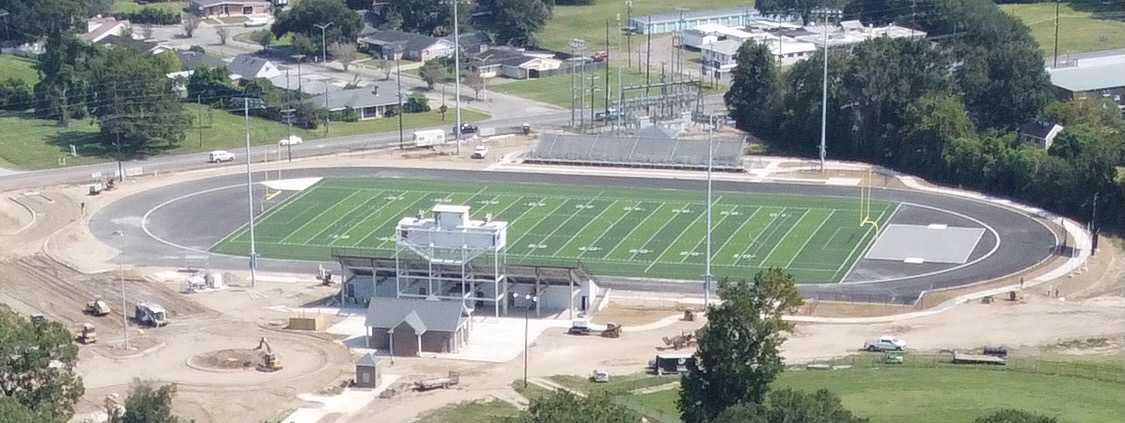
Donald Gardner Stadium on September 11, 2025. A $10,000,000 investment that represents the largest non-infrastructure expenditure in city history.